Via Ingram
Today, the environment is facing many changes in climate and temperature, and those feeling its most prominent effects are the poor and indigenous communities who live in natural, self-sustaining ecosystems like the Amazon Rainforest. Currently, the indigenous people are facing many threats to their way of life from deforestation, large scale agriculture, and river pollution.
The trees in the Amazon Rainforest are being cut down at a very rapid rate. This extreme change has effects on not only Brazil and the Amazon, but on the entire world as well. In 2019 alone, around 78 million acres of trees and forest land in the Amazon Rainforest was either logged or burnt. Those trees are crucial to the future of the earth, as they absorb 20% of the carbon produced by the world every day. The forest also provides shelter to all who live there. The canopy, or the uppermost layer of the rainforest, helps regulate temperatures in the Amazon, allowing it to maintain its humid temperature. With the rapid deforestation of many trees, it can cause an abrupt and unexpected change in temperature, which will threaten the almost 11 million plant and animal species who call the Amazon home. With a substantial temperature rise, trees will produce fruits and nuts later or earlier in the year, which will throw off the many animals who rely on them for food. Higher temperatures will also let new parasites into the area, who will bring a disease with them.
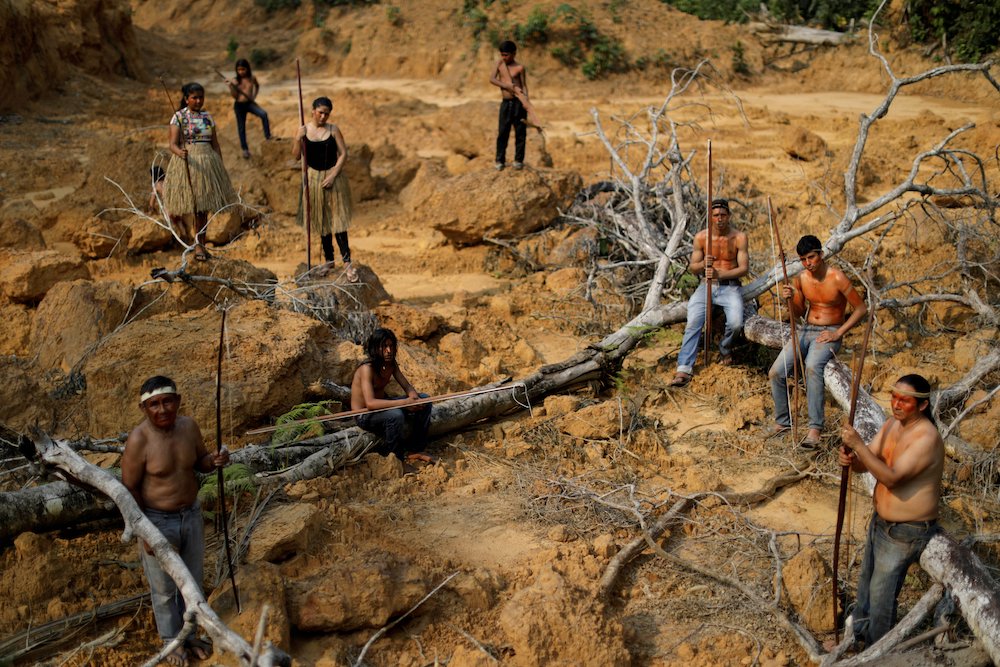
Deforestation is affecting the indigenous communities of the Amazon substantially. Mining and farming companies have set parts of the Amazon ablaze to clear the land. Due to this, many indigenous tribes are having to adapt to the post-fire effects. Those who are part of the tribes are being burned alive, or choke on the smoke that fills the area, while other tribes are facing forced displacement from their demarcated land, and are now homeless and unable to provide for their families.
Another reason why the indigenous communities of the Amazon are threatened is due to an increased amount of large scale agriculture in the Amazon. Large scale agriculture in the Amazon refers to the many large companies that grow mass-produced meat, produce, and dairy over a huge area of land. To get cleared, open land, these companies burn the forest, and many times, they also illegally burn land inside of indigenous reserves. Large scale agriculture is one of the leading causes of deforestation in the Amazon.
In addition to deforestation, large scale agriculture also uses pesticides, herbicides (weed killers), and chemical fertilizers in excess. As companies spray gallons and gallons of pesticides and herbicides onto their crops, the air becomes more and more polluted. Air pollution by these chemicals occurs when the wind carries the fumes of pesticides to other places. Breathing this air over a long period of time will negatively affect the long term health of those who inhale it. As mentioned before, the industry of agribusiness also uses chemical fertilizers. The main harm of chemical fertilizers is that they contaminate rivers. The runoff that results from watering the crops often makes its way into rivers. This is alarming because the runoff contains several dangerous chemicals, and by entering the water, they are polluting the river.
Large scale agriculture is mainly harmful to the indigenous because most farms are relatively near many indigenous reserves. The indigenous have settled on plots of land with the most fertile soil, however, those locations are also the best place to farm. When the tribes breathe the polluted air and drink the polluted water for as long as they live on their demarcated land, it will result in serious harm to their health. Some of the short term health effects of consuming the polluted air and water include the development of allergies, nausea, vomiting, diarrhea, headache, loss of consciousness, extreme weakness, and seizures. Some of the health effects that result from long term consumption and exposure to polluted air and water include Parkinson’s disease, Asthma, Attention Deficit Hyperactivity Disorder (ADHD), Leukemia, Non-Hodgkin’s Lymphoma. These diseases usually result from constant exposure at low levels over many years.
The Amazon Rainforest contains one of the greatest quantities of freshwater worldwide, and it is relied on by the millions of plant, animal, and fish species who call the rainforest home. Rivers in the Amazon have lately been facing an increased amount of pollution. Some of the main causes of the destruction of rivers in the Amazon include dam-building, overfishing, mining, and agriculture. The increased use of dams will disrupt the flow of the water, which can prevent natural fish migration. Overfishing has decreased the amount of fish there are for other animals to consume. Mining leaks chemicals such as mercury into the water, which is extremely harmful to consume. Agriculture in the Amazon, particularly Brazil, uses a lot of pesticides, herbicides, and chemical fertilizers, which when leaked into the water, either by rain or fumes carried by air, is a severe threat to the animals, plants humans and fish who either live in or consume the polluted water.
For centuries, the freshwater in the Amazon Rainforest’s many rivers has been vital to the survival of indigenous tribes. They have used the freshwater as one of their primary sources of water for their crops and drinking water. Nevertheless, the rivers are being polluted at an alarming rate. One of the most impactful ways the rivers are being polluted is nickel and gold mining. Due to an excessive amount of mining in the Amazon, mercury is being leaked into the water. If mercury is digested, it is known to cause severe harm to those who consume it.
One example of the pollution faced by the Amazonian river tribes is with the River Cateté and the Xikrin Tribe. The Xikrin Tribe has lived along the River Catete for centuries. Their way of life depends on easy access to its clean and fresh water. Surrounded by an ample amount of vegetation, the Xikrin people swim, bathe, and fish in this river. However, the river has recently been facing extreme pollution by nickel mining, which could severely hurt the population of the Xikrin, and eventually lead to the extinction of the tribe. A mining company called Vale — which extracts nickel from nearby hills — has been polluting tributaries that flow into the river. The Xikrin people —who drink this water and eat the fish that come out of it, began suffering itchy skin and burning eyes as some of the less intense symptoms of the water contamination. According to anthropologist, Lux Vidal, “ Nickel is the worst of things that can happen. It is the most polluting ore, the most lethal ore there can be.” In 2015, a professor at the Federal University of Para conducted a test that found traces of nickel in the sediment of the river at almost double the safe level downstream from the mines, but no trace upstream, which proves that the mines are the cause of the water contamination. The tests also found unsafe levels of iron, chromium, and copper.
According to many indigenous activists, such as Sonia Guajajara, there are many ways to help the indigenous. One of these methods includes stopping using products made through companies who pollute or invade their home. By doing this, companies will have a choice — either go out of business or stop polluting and invading their land. According to Sonia, the best way to protect the indigenous is by choosing products made by companies that are responsibly sourced. Before buying a product, research the company that made the product, and find out if they are affecting people positively or negatively.
Works Cited
Hofmeister, Naira Cícero, and Jose Cícero da Silva. “’ The River Is Dead’: Is a Mine Polluting the Water of Brazil’s Xikrin Tribe?.” The Guardian. 15 May 2018. The Guardian News and Media. 10 February 2020.
<https://www.theguardian.com/global-development/2018/may/15/brazil-xikrin-catete-river-amazon>
Nunez, Christina. “Explore Our Rainforests.” Rainforest and Amazon Facts and Information. 15 May 2019. National Geographic. 5 February 2020. <https://www.nationalgeographic.com/environment/habitats/rain-forests/#close>
Casado, Letícia, and Ernesto Londoño. “Under Brazil’s Far-Right Leader, Amazon Protections Slashed and Forests Fall.” 28 July 2019. The New York Times. 7 January 2020.
<https://www.nytimes.com/2019/07/28/world/americas/brazil-deforestation-amazon-bolsonaro.html>
Elassar, Alaa. “Amazon Deforestation Rate Hits Highest Level in Over a Decade.” CNN. 19 November 2019. Cable News Network. 30 January 2020.
<https://www.cnn.com/2019/11/19/americas/brazil-deforestation-amazon-2019-trnd/index.html>
Parsons, James J and Alarich R. Schultz. “Ecological Concerns.” Amazon River. 23 December 2019 Encyclopedia Britannica, Inc. 10 January 2020.
<www.britannica.com/place/Amazon-River/Ecological-concerns.>
Cotovio, Vasco. “Amazon Destruction Accelerates 60% to One and a Half Soccer Fields Every Minute.” CNN. 2 July 2019. Cable News Network, 24 Jan 2020. <https://www.cnn.com/2019/07/02/americas/amazon-brazil-bolsonaro-deforestation-scli-intl/index.html>
Metuktire, Raoni. “We, the Peoples of the Amazon, Are Full of Fear. Soon You Will Be Too | Raoni Metuktire.” The Guardian. 2 Sept. 2019. Guardian News and Media. 12 February 2020.
 The Megaphone