Li Chen He

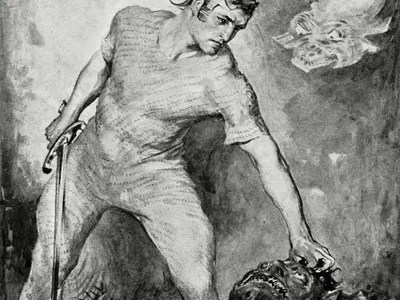
The debate between Unferth and Beowulf from lines 499 to 606 provides a sharp contrast between the hero, Beowulf, and the ‘antihero’, the exile, Unferth. Beowulf completely undermines Unferth’s argument and in turn is able to insult Unferth, which shows the capability and mental fortitude of the hero. On the contrary, Unferth completely ruins his reputation and seems foolish. This section of the text is effective in showcasing Beowulf’s abilities and highlighting the traits that separate the hero from an exile.
The debate begins with Unferth remarking about the swimming match between himself and Breca. Ironically, the rest of the debate does not go swimmingly for Unferth. Unferth sees the amount of respect that others are giving Beowulf and becomes very jealous. In his mind, he was the main character; he was the special one. He cannot bear seeing others having more power or influence than himself. This immediately shows his self-importance and vanity; it also shows how hypocritical he is when he accuses Beowulf of being vain and foolhardy. In his attempt to go against Beowulf, Unferth claims that he heard that Beowulf had lost in a swimming match against another prince, Breca. The connotation of the statement is the idea: ‘if he can’t even beat another prince at swimming, how would he be able to defeat Grendel?’ The statement makes it seem like Beowulf is only exaggerating his worth to look the part of a hero. Additionally, he states that Beowulf recklessly challenged Breca to a swimming match in the open sea, and phrases it in a way that gives Beowulf the impression of being foolhardy, vain, and impulsive. It sounds like Beowulf just wanted to show off, so he challenged Breca to an open swimming match, having no regard for the safety of himself and Breca. The Danes might hear these claims and believe that Beowulf wanting to save them was only an impulsive act that Beowulf made to look ‘cool’. And while Unferth is speaking in a tone that makes him sound worried that the people’s hopes will be dashed by Beowulf’s ‘villainous lies’, Unferth is just jealous and is using the rumor he heard about Beowulf to his advantage to make Beowulf lose face. Unferth’s whole argument revolves around being able to diminish Beowulf’s respect and in turn increase his own, which is a tell-tale sign of his vanity as well as insecurity.
Upon hearing Unferth’s attempt at undermining his honor, Beowulf immediately responds. With a cool tone, he begins by calling Unferth ‘friend’, which is sarcastic, and simply remarks, “you have had your say about Breca and me,” (Beowulf, 530) which undermines Unferth’s whole argument to just be the rant of a jealous and vain fool. This immediately starts off the retort with a cool and smooth response. He goes further, asking if perhaps Unferth has been spending too much time in the mead hall drinking. After accusing Unferth of being a drunkard, Beowulf then explains what really happened in the swimming match against Breca. Beowulf starts by boasting that he was the strongest swimmer in the sea; however, he could not swim faster than Breca, nor could Breca swim faster than him. They were evenly matched. By stating that he could not swim faster than Breca, it gives Beowulf an air of humility, which contrasts nicely with the vanity that Unferth had previously revealed. Adding this clever detail not only shows that he is not vain like Unferth, but also reinforces the idea that he is physically strong as well. Additionally, he addresses Unferth’s implication and mentions that the match was respectfully called between Breca and himself and that they had even brought swords and armor to protect themselves. Now reaching the integral section of his boast, Beowulf explains how he was attacked by not one, but eight sea monsters, and how he heroically killed all eight of them. This statement is shocking; killing eight sea monsters was unheard of, a feat that only a great hero could have accomplished. The boast is almost like a slap in the face for Unferth; Unferth expected to tear down Beowulf’s confidence and prove how ‘untrustworthy’ and ‘weak’ Beowulf really is, but instead, he gave a chance for Beowulf to further his good reputation. After speaking about that great display of strength, Beowulf ingeniously decides to narrate how he was barely able to swim to the land, and that the ocean ‘lifted and laid me ashore’ (Beowulf, 579). This section of his rebuttal humanizes Beowulf from a God-like figure to a normal human being with imperfections; it allows the audience to understand that although he is a hero, he is subjected to the same rules under God as everyone else. In addition, the phrase ‘lifted and laid me ashore’ gives the impression that God saved Beowulf and brought him to safety. Beowulf is able to cleverly destroy Unferth’s argument and is even able to turn the favor towards himself with his boasts of strength and power.
This next section is the core of Beowulf’s rebuttal to Unferth’s claims. Beowulf shows how vicious he can be with his insults and displays his argumentative strength. He first offhandedly and condescendingly mentions that neither Unferth nor Breca are capable enough to even survive being attacked by eight sea monsters because of their unremarkable skills, which definitely puts Unferth in his place. He then reminds Unferth that although he is still able to live in society, he is still an exile, a dishonorable brother killer, a person that is in no way respectable, has no honor, and has no right to even consider being as great as himself. He emphasizes that they are different; a hero and an exile. Beowulf also notes that Unferth is the vain one; he points out that Unferth is just bitter that he is not seen as the hero that will save everyone. He goes on by stating that if Unferth was really that jealous of him, then why wasn’t he the one to save everyone? If Unferth was nearly as courageous or strong as he alluded to, then would Grendel still be there? Would the Danes be so helpless against Grendel and need Beowulf to help them? Would the land not suffer? Beowulf thinks not, and makes the audience know. This brings attention to the cowardice Unferth has compared to Beowulf, and provides a very nice reminder that Beowulf is not in any way obligated to help the Danes. This part of the speech reminds me of a rattlesnake rattling its tail; Beowulf warning Unferth not to push his buttons anymore or else the Danes will be getting no help. It is a threat, saying that the disrespect that he is getting is completely unacceptable and he clearly sets his boundaries of what is way too far.
Reaching the end of Beowulf’s two-and-a-half-page-long retort, Beowulf scorns the Danes, remarking, “He knows he can trample down you Danes”, (Beowulf, 599) meaning that Grendel knows that he can continue to attack the Danes over and over because they are helpless against him. This again implies: ‘If Unferth doesn’t respect me then I’ll let Grendel continue trampling down on you’. Beowulf establishes the fact that he is integral to their safety. Beowulf finally finishes off with a boast that he will be able to defeat Grendel, and that soon, Grendel will fear his might and power. With the whole speech and proof of his might ahead of this bold claim, it does seem possible and nicely closes up the whole speech by reaffirming his might and restoring his honor.
This whole section of the text shows a great contrast between Beowulf and Unferth, hero and exile. As Beowulf had stated, Unferth’s insult towards Beowulf was rude; Beowulf had kindly arrived to help them, but Unferth is hostile and questions Beowulf. Even Hrothgar could swallow his honor and pride by letting Beowulf help them. Unferth’s insulting of Beowulf is extremely rude to both the king and Beowulf, which causes Wealhtheow to raise her cup to Beowulf, basically telling Unferth to stop. On the other hand, Beowulf’s refute can assert his might, courtesy, and restraint, and shows that he not only is strong physically but also mentally. Compared to Beowulf, Unferth looks foolish, and spiteful, like a person driven by vanity and their insecurity. Beowulf can retain a good image of himself and lower Unferth’s reputation by pointing out Unferth’s flaws. The debate between Unferth and Beowulf successfully displays the difference between the hero and the ‘anti-hero’; how one is strong and intelligent, and the other is weak and cowardly.
 The Megaphone