Via Ingram
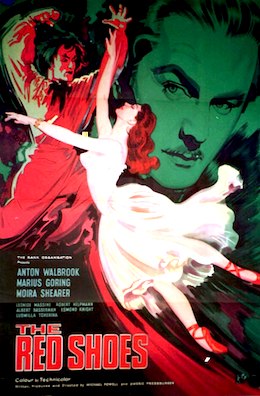
Your best friends, the people you admire, your greatest desires, and your personality— all dependent solely on your point-of-view; what people have shown of themselves to you, and what parts of the world you’ve seen, as well as the viewpoints you’ve made and continue to experience the world while carrying based on other things within your viewpoint. The world can only be as much as you are able to experience. In “Dying for Art”, Ian Christie argues that point-on-view is central to the conception of The Red Shoes, specifically the audience’s POV and their experience. Everything including the image of the characters must be aptly conveyed to the audience. As the article says, the first scenes and their usage of camera angles as well as other cinematic elements for the purpose of establishing the character of Boris Lermontrov, a famed impresario, as the “high priest” of ballet. The following scenes’ analyses will further this point, illuminating the way in which a variety of shots, as well as a couple of other cinematic elements, were used in this film to create an accurate experience of the conversations between the characters for the viewers.
The source of much of the conflict in this movie comes from the relationship between Boris Lermontrov, mentioned previously, and Victoria “Vicky” Page, an up-and-coming ballerina. The first meeting of Vicky and Lermontrov is introduced in a scene where Vicky’s mother, who is attempting to get Vicky cast as a ballerina by Lermontrov, approaches the impresario with the motive of convincing him of this goal. Vicky’s mother approaches Lermontrov, who is seated in the room, while the camera films him from the back. She then sits down next to him and begins to talk about the possibility of recruiting Vicky as a dancer. When filming the two conversing, the camera never films anything other than close-up shots of the two’s faces, alternating their focus based on who is speaking. They are also never shown in the same shot during this sequence. Additionally, while Boris talks to Vicky’s mother, purely his side profile is filmed and much of his side profile is covered by a shadow coming from behind him. The camera also films him from the back, behind the line of eye contact the two characters create as they converse while sitting side by side. These factors all depict the tension created by this conversation as well as the distance in the relationship between the two. When filming Vicky’s mother, the camera still films from behind their line of eye contact, and it films the side of her face, however, rather than purely her side profile, more of her face is filmed when she talks than Boris’, showing that the barriers that are preventing their conversation from being smooth and tension free are put up by Boris. Furthermore, when Boris gets up and begins to end the conversation, the camera continues to film only one side of his face, up until the point when he finally says goodbye to Vicky’s mother, wherein he walks away, and the camera films his back. Contrastingly, after Boris walks away, the camera films a final close-up shot of Vicky’s mother’s face, where she says to herself, in reference to Boris, “Attractive brute!”. In this shot, the camera films not from the side of her face, but a straight-on shot, further showing that the tension and the lack of smoothness in their conversation, which were depicted by the uncomfortable angles, was mostly created by Boris, as an expression of his unwillingness to hear Vicky’s mother out, and after Boris gets up to leave, the mysterious angles are no longer used to film Vicky’s mother. In contrast, the viewers are never shown more than one side of Boris’ face during this conversation, and it ends with viewers being shown even less—only his back as he walks away, showing that Boris’ disinterest has been maintained and that Vicky’s mother has not attained his approval. Another difference between the final shots of the respective characters is that Vicky’s mother is filmed in a close-up, while Boris’ exit is filmed in a wide shot. Boris’ wide exit shot is calm and shows Boris’ indifference. Boris in this shot is small and surrounded by people and calmly walks out of frame while the camera is still. We also do not see his face, so no emotion is conveyed, contributing to an overall lack of dynamism. Contrastingly, close-up shots are, in nature, dynamic, as they focus on the expression and emotions of the character. Boris exits this tension-filled exchange indifferent while Vicky’s mother is left feeling like she has been impolited. This is an example of what the Modelski article says about Boris’ personality and his overall controlled and unemotional nature, as well as his indifference towards anything other than ballet, including politeness.
Then, in a scene that occurs soon after, Vicky and Lermontrov finally talk for the first time at the same party. Since the scene discussed above, Boris has not been shown at all in the movie. This scene begins with a wide shot that films both Vicky and Lermontrov. The camera sits in an inner corner of the room, and films the inside of the room as well as the doorway. Here, Boris is inside the room while Vicky is entering through the doorway, so Boris is larger in comparison to Vicky and is the subject of this shot. Additionally, only the side of Boris’ face is filmed once again, while Vicky walks into the room facing the camera. Vicky then moves next to Boris— still further away from the camera than him. Boris notices her and makes a comment to her about the fact that she does not look happy for someone at a party. This piqued his interest because he, too, is not “happy” at this party, and he is interested by this quality they share. It is here that another sequence of interchanging close-up shots begins to show their conversation. This one is similar to the one that occurs in the first scene, however, there are several major differences. First, while Boris is still not filmed by straight-on shots and a shadow is still cast over part of his face when he speaks, both sides of his face can be seen, instead of just a pure side profile, and there is less of a barrier between the two, showing Boris’ interest in Vicky compared to Vicky’s Mother. Additionally, their shots are filmed from the front, side of the person, rather than the back, side, or beyond their line of eye contact, showing more closeness between the two, and more openness on Boris’ part. Next, when Vicky is filmed, a similar amount of her face is shown in the shot as is Boris’ showing that they have similar power in this conversation and are interested in each other, rather than it being a one-sided relationship. Then, Boris, who is not aware of who Vicky is, begins to talk about his dislike for the previous conversation he has had with Vicky’s mother. Vicky tells Boris that she is the daughter of the woman he just talked about. Boris is visibly taken aback by her revelation and apologizes to Vicky, showing care for tact that he lacked in his interaction with her mother. In this scene, we are once again shown only the side profile of his face, but when he apologizes, he swivels his head on his neck nervously several times, interchanging a view of the front of his face with the same side of his face. This nervousness and lack of control on his part in terms of how much of his face he allows the viewer to see based on the location of the camera show how he has lost control of this conversation. This can be compared to both Vicky’s head movement in her close-up shots in this scene and the movement of Boris’ head when he was talking to Vicky’s mother. Vicky’s head is very still, however, unlike Boris in the state when he is in control, the camera films more than just her side profile, allowing the viewers to see the entirety of her face. This shows how she has control in this conversation, however, does not want to completely shut Boris out, and is open to some kind of future with him. She confronts him, and he, having been impressed by her, offers her another audition on the spot, where he asks her the question: “Why do you want to dance?”. In this shot, Boris matches the stillness of Vicky’s head and the angle that films her head, showing the viewers the entire front of his face. Additionally, he moves from an angle that shows more of one side of his face to an angle that is closer to a straight-on shot, showing that he, too, is open to a future relationship. Vicky responds with “Why do you want to live?” and Boris understands immediately. In these shots, they are both filmed in similar ways, with a shot that shows most of their face and above the shoulders. This placement is also fixed. These things show how they view each other as equals. After hearing her answer, the shadow which blanketed half of Boris’ face in the shot where he asked her the question previously has lightened, and this “audition” period where they had to prove themselves to each other has ended. For example, the faint piano diegetic music playing in the background ends, and the other people at the party begin to applaud. In the final close-up shot of this scene, Boris puts down his drink and turns in a circle so that the side of his head, the only section which the viewers have still yet to see is shown. Simultaneously, the camera cuts from Boris’ close-up shot to a wide shot that films both of them walking away with their backs to the camera, putting them in the same class. Furthermore, they walk away and a butler passes in between the pair This is also the first time since Vicky stood next to him initially that they have been filmed in the same shot together, not in a close-up. Lastly, Vicky is now the subject of this shot, showing that her status has changed since the beginning of this scene and she has earned his respect.
 The Megaphone