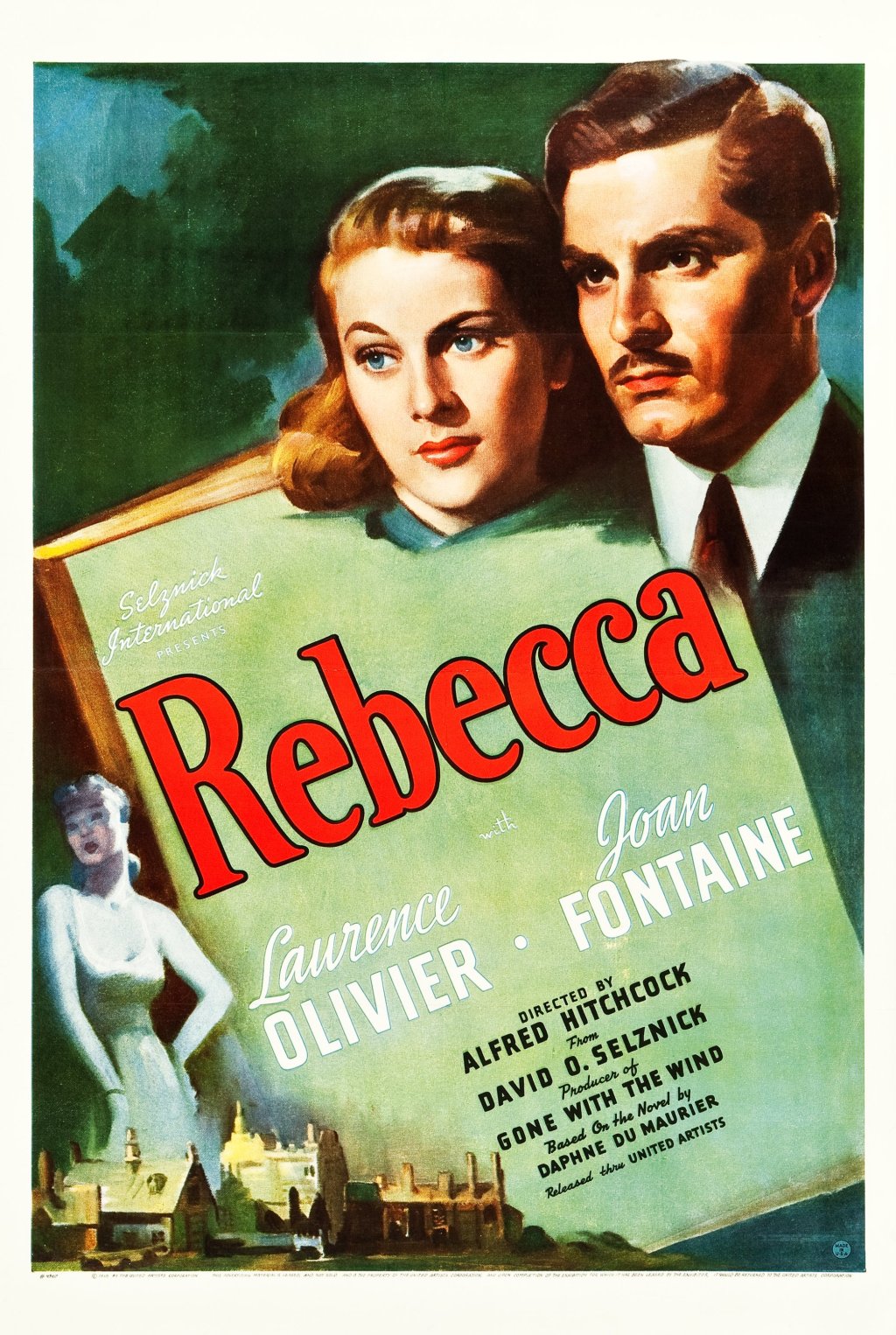
Via Ingram
In the movie, Rebecca, the main character, is nameless, except for her last name, which she gets from the man she has married. The main character is constantly contrasted with her husband’s late wife, Rebecca, who the film is named after. In comparison to the childlike, identity-lacking main character, Rebecca is a very charismatic, enchanting and powerful character. This is emphasized in the film by the fact that neither a picture, nor a moving flashback of her is ever shown. Similar to the shark in the movie, Jaws, Rebecca gains power over from the fact that there isn’t a face, nor any physical qualities, except for her black hair, to match her extraordinary description. The fact that she is such a mystery to the viewers gives her presence/mention the weight that it has in this film. The fact that she is so mysterious makes it very hard for her to be devalued as well.
The main character’s insignificance is shown well in the scene where the main character enters Rebecca’s room for the first time. This scene begins as a result of previous events that have piqued the interest of the MC regarding Rebecca’s side of the house. The main character stands at the top of the staircase looking at the closed door that leads to Rebecca’s old room. In this scene, Rebecca is obviously not there, yet the main character is afraid to mess anything up and even enter her old room, which is in the house she is now the hostess of. This displays the power that Rebecca’s presence has over the MC, who doesn’t want to upset (and seeks the approval of) Rebecca. When she is first debating whether or not she should enter the room, the camera films her in a very wide shot, causing her to be dwarfed in comparison to the walls of the house, displaying her insignificance. Also, when she looks around to check if anyone is watching, the camera stays still, and the shot wide. This makes her look naive, insecure, and almost stupid, as in she is worried about things that aren’t even there, in the same way that young kids are worried about a monster in their closet, etc.
Then, the main character enters the room. When she does this, the placement of the room’s lightsource in relation to where the MC is standing creates a large shadow that slowly gets smaller as she walks on, emphasizing her smallness. Lastly, she slips through a white divider into the next room. Her actions and mannerisms show her being very worried about being in that room and making a mess, giving the impression that she is intruding into a place she doesn’t belong, in her own house, making Rebecca’s influence over the estate even more clear.
When Maxim de Winter and the main character first meet, Maxim de Winter is staring out at the sea at something we cannot see. In a chronologically normal suture, the woman is first presented as the subject of look by an unknown observer, who is later made known in the reverse shot. However this scene prevents a reverse-suture, where the subject of the look (who we infer to be Rebecca) is the unknown one and the observer (Maxim de Winter) is known from the straightaway. First, the fact that the MC plays no part in this interaction, creates an unsettling feeling for the viewers, who now are hoping to see the MC become validated by the male gaze and Maxim de Winter. Then, when it is found out that he was most likely looking at his late wife, and we are told to believe that he is still in love with Rebecca, this scene enforces the idea that Rebecca is who the MC must become in order to gain the affection of the man in this situation. This directly shows her lack of identity.It also shows the fact that she will grow out of Rebecca’s shadow as the film progresses and Rebecca is no longer who she needs to be to gain her husband’s attention. She in fact, needs to be the opposite of Rebecca, which is what she already is, despite not being much.
 The Megaphone