Author: Eric Li
The human obsession with the future began to take a structured, artistic form in 1909 when the Italian poet Filippo Tommaso Marinetti coined the term “futurism” to describe a world defined by speed, danger, and the swift efficiency of the automobile. This early movement rejected the immobility of past literature and the “sleep” of museums, urging creators to instead find beauty in struggle and the “omnipresent speed” of the industrial age. Artists like Giacomo Balla and Umberto Boccioni translated these ideals into visual form, using blurred, repeated lines and polished metals to depict dachshunds skittering on leashes or marching figures that appeared literally “carved by speed”.
While early futurism celebrated machines, later movements adapted these interests to imagine liberation for specific communities, most notably through Afrofuturism. Coined by Mark Dery, this aesthetic combines science fiction, history, and fantasy to explore the African American experience and recover “histories of counter-futures”. It often bridges two distinct timelines: the historical reality of slavery and its aftermath, and a cosmic time that reaches from a mythical past into a technologically advanced future. This is reflected in works like Ellen Gallagher’s “Ecstatic Draught of Fishes,” which envisions survivors of the Middle Passage living in high-tech cities beneath the ocean, or the evolution of Marvel’s Black Panther, which moved from “jungle avenger” tropes to a monochromatic, high-tech cinematic aesthetic.
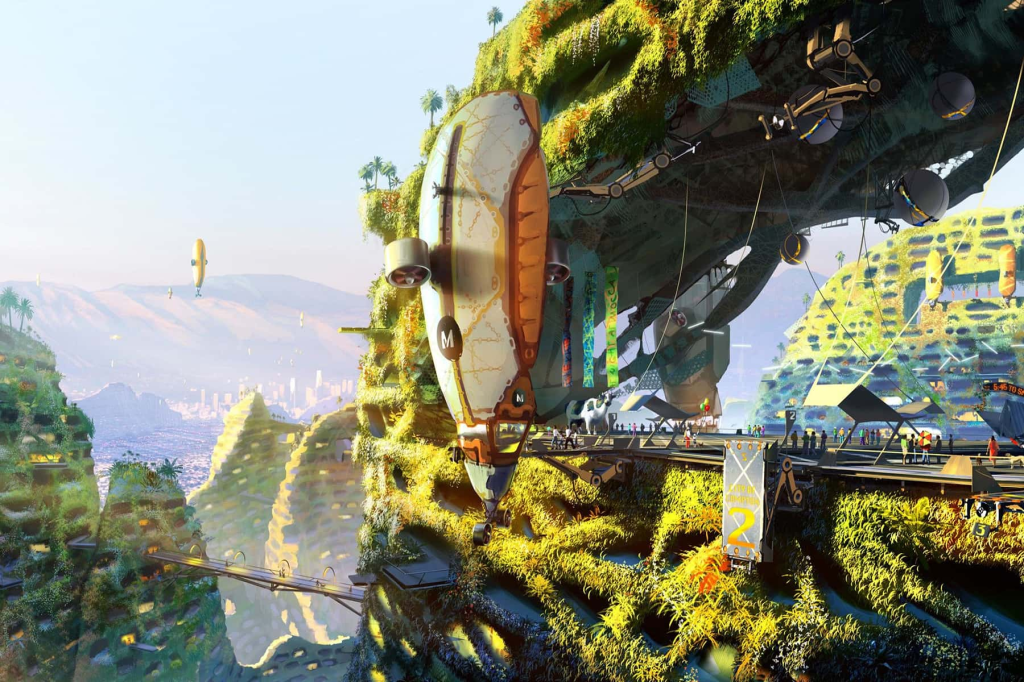
In contrast to the sleek, often market-dominated visions of the future, solarpunk offers a more optimistic perspective where technology and nature exist in harmony. This movement emphasizes grassroots environmental action and community resilience, often visualized through biophilic architecture featuring vertical forests and solar panels. Real-world examples of this philosophy include Singapore’s “Garden City” initiatives and innovative “agrivoltaics” facilities that use solar infrastructure to increase crop yields. In media, this spirit is captured by the works of Hayao Miyazaki, such as Nausicaä of the Valley of the Wind, and video games like Terra Nil, which focus on restoring the bond between humanity and the earth by transforming barren wastelands into balanced ecosystems.
The “Atomic Age” of the 1950s and 60s inspired a different branch of futurism known as atompunk, which imagines a world where nuclear power continued to flourish into the present. This style is characterized by “clunky” cathode-ray technology and an obsession with nuclear energy combined with the aesthetics of the Space Race, as seen in The Jetsons or the Fallout series. While some pop culture from this era used atomic metaphors playfully—such as the song “Atom Bomb Baby” describing a woman’s explosive allure—others used it for protest. Vern Partlow’s “Old Man Atom” warned that all men might be “cremated equal” by the bomb, a sentiment so controversial during the McCarthy era that the singer was blacklisted. Whether through the lens of nuclear anxiety or ecological hope, these various “punky futures” reflect the shifting ways humanity attempts to visualize what lies ahead.
 The Megaphone