Author: Grace Li
In this installment of our Student Spotlight Series, we had the pleasure of interviewing Temple Literary Magazine, a group of young creatives dedicated to highlighting Asian American identity through writing. With me is Faith Choe, the founder and Editor-in-Chief of Temple Literary Magazine.
Q1. Please introduce yourself and Temple Literary Magazine.
Hello, my name is Faith Choe and I am the Founder and Editor-in-Chief of Temple Lit Mag. I am a Korean American artist, writer, musician, and poet that creates prose, poetry, and art revolving around my Asian American identity. Temple Literary Magazine was made to be a platform for Asian American youth writers to express their voices freely and bring attention to the devaluation of Asian American struggles. Additionally, Temple Literary Magazine was created to share cultures from many different Asian countries so writers can share their cultures with pride and be published for it.
Q2. Your magazine highlights the duality of Asian American identity: how do you encourage submissions that move beyond that “in-between” narrative and explore less commonly represented experiences?
We encourage submissions like this by making it clear that we accept writing that may seem “risky.” I know that there are many raw and visceral moments in growing up Asian American, so I encourage writers to share their own writing that truly expresses their emotions, rather than just “playing it safe” to please a magazine. We accept submissions with religious imagery, violence, topics of mental health, and others and are honored to be trusted such sensitive work.
Q3. Is there a moment or experience that inspired you to create Temple Literary Magazine? How does this guide how you lead the magazine?
Throughout my childhood, like many other people of color, I was racially discriminated against as well as stereotyped. One memory from my childhood I frequently think about is my father frantically rubbing laundry sheets on my clothes so I wouldn’t smell like Korean food. He told me he did this because he didn’t want the other kids to make fun of me like how they did to him, going to American school in the 70s and 80s.
Many of the experiences I faced made me struggle with my mental health because as a little girl, I didn’t realize that I wasn’t being punished for being a bad kid. I was being treated unfairly because of my ethnicity. Hearing stories from my friends made me realize that there is so much stereotyping and hardships Asian Americans go through, but they don’t know who to tell. I created Temple Lit Mag so Asian Americans know that they have a safe space to show their writing to, as well as showcasing their works to the world to amplify their voices.
Q4. Temple Lit Mag is “run by teens, for teens”- what advantages do you believe the youth perspective gives you over traditional literary magazines?
Being a writer myself and submitting to many magazines, I realized that many of them were mainly built for adults and it was hard for youth writers to submit their writing and be accepted. Many teen writers have voices and skills just like adult writers do. I feel that teen editors are able to understand pieces written by other teens in more depth and emotion, because we share the same experiences and emotions. The youth perspective we have gives us a more open mind and a higher ability to understand other teen writers, which gives us an advantage.
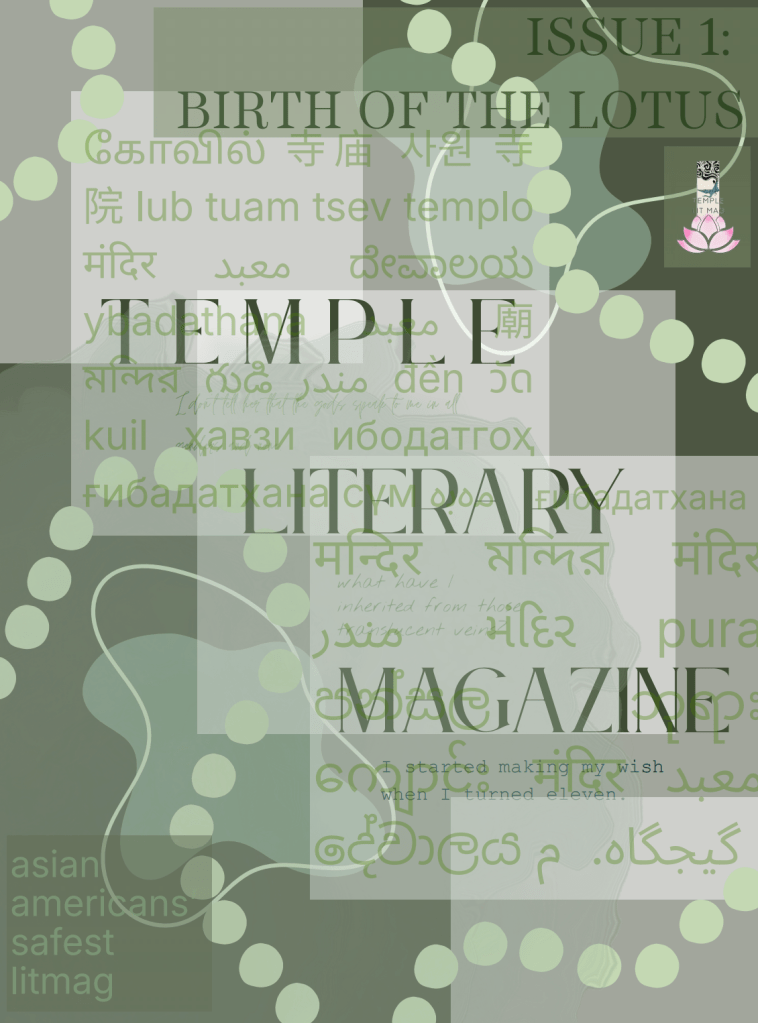
Q5. Your first issue is centered around “Birth of the Lotus”. What does this phrase mean to you, and in the context of the pieces published in Temple Literary Magazine’s first issue?
I named our first issue Birth of the Lotus because it was inspired by the term “lotus birth.” A lotus birth is the practice of leaving the umbilical cord uncut after giving birth so that it can detach from the mother naturally. People believe that this gives a calmer transition for the baby and close connection to the mother. I thought of this as how Asian Americans may live far away from their mother country, their bond between them and their mother country is never uncut and they will always be tied to their heritage.
Thank you so much to Faith for representing Temple Literary Magazine as part of this interview! Please find Temple Literary Magazine’s work here: https://linktr.ee/templelitmag
 The Megaphone