Author: Grace Li
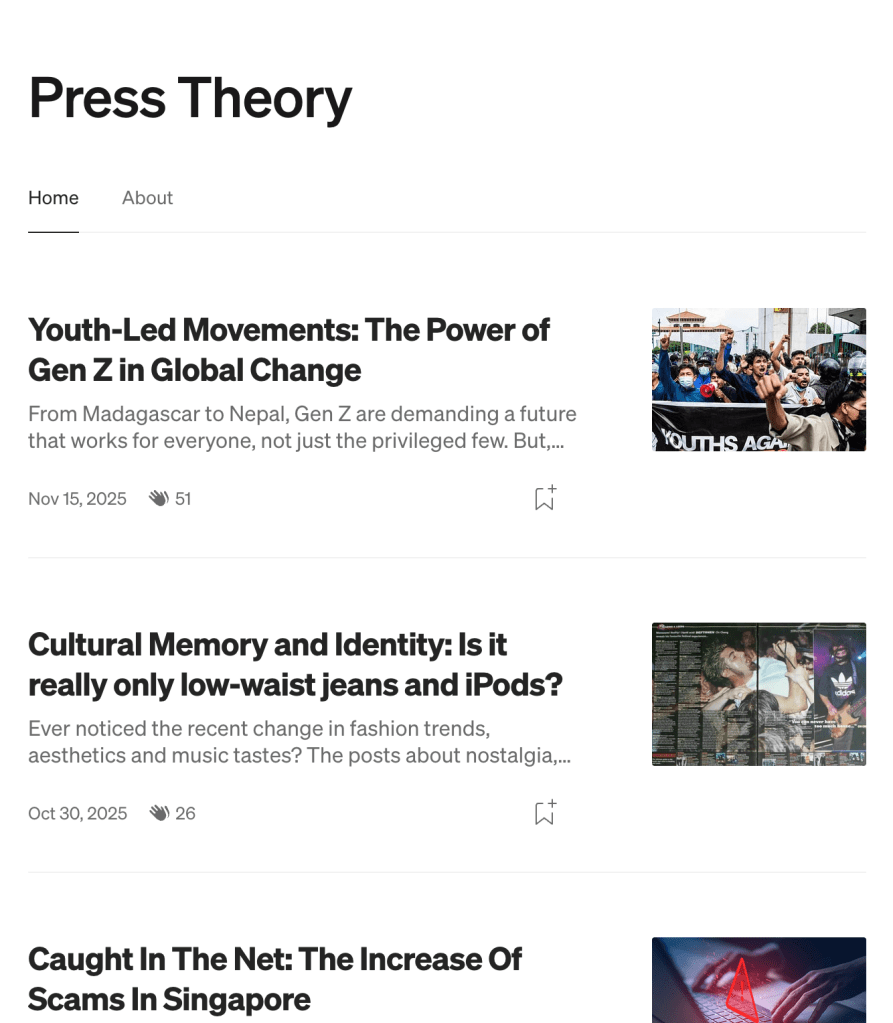
We are so happy to have Shanelle, the founder of Press Theory, in this interview as a part of our Student Spotlight Series. Press Theory is a student-led organization that applies theories from the humanities and social sciences to local and world events.
Q1: Please introduce yourself and the mission of Press Theory.
My name is Shanelle, and I am the founder of Press Theory, a student-led initiative that connects current affairs with ideas from the humanities and social sciences.
The mission of Press Theory is simple: to explore the “why” behind the “what.” We look at news stories and unpack the deeper historical, social, cultural, and political forces that shape them. Rather than consuming news as isolated events, we encourage readers to see patterns, systems, and recurring themes that influence our world.
At its core, Press Theory aims to make social theory more accessible and conversational. I aim for knowledge not to be confined to classrooms or academic journals, but instead applied to everyday realities in ways that are understandable and relevant to young people.
Q2: Is there a specific moment or experience that led you to start Press Theory? How does this moment influence your work?
There was a particular news story involving a 9-year-old primary school student who faced severe bullying, and what struck me was not only the incident itself but the institutional response surrounding it. It raised questions about accountability, reputation, and how different societies handle conflict and public image.
That moment made me realise that news is rarely just about the event being reported. Instead, it reflects broader cultural norms, institutional structures, and social priorities. I began to see how many issues are shaped by deeper forces that often go unexamined in mainstream reporting.
This experience continues to influence my work today. It reminds me to approach stories with both analytical depth and sensitivity. Behind every headline are real people and real systems, and Press Theory strives to examine both responsibly.
Q3: Which article are you proudest of, and why?
One article I am particularly proud of is “When Attention Becomes a Valuable Form of Currency.”
The piece was inspired by a local incident involving a publicity stunt that led to serious consequences. While it initially seemed like another effort to gain online attention, it raised a deeper question for me: why do people risk their reputations, face legal issues, or face public backlash for visibility? In the article, I explored how attention has become a type of social currency in the digital age. Social media platforms reward visibility, engagement, and virality, sometimes without regard for whether the attention is positive or negative. This creates an environment where the line between publicity and recklessness can blur.
I am proud of this piece because it reflects what Press Theory represents. It takes a seemingly isolated event and places it within larger social and cultural patterns. Instead of judging the individual involved, the article looked at the structural incentives of the attention economy and questioned the long-term effects of living in a society where visibility equals value.
Q4: Why do you believe it is important to bridge theory and reality via newswriting? How have you found that this translates into change within your local or global community?
Theory provides language. It gives us ways to express patterns that we may sense intuitively but find hard to describe. Without theory, news can feel fragmented and reactive. With theory, we begin to see how events connect to history, power structures, cultural norms, and collective behavior.
Connecting theory and current events encourages more thoughtful reflection, shifting the focus from quick reactions to deeper understanding.
While Press Theory is still developing as a project, I have noticed small but meaningful shifts in our readers and student volunteers alike! Volunteers have mentioned that they now approach issues with more awareness, while readers have expressed gratitude for having complex ideas explained clearly.
To me, even starting conversations about issues is a form of change. It can help to foster critical thinking, which is essential for any larger social transformation.
Q5: How can students aid in your mission?
Students can contribute in many ways, including as writers, editors, researchers, or even just as thoughtful readers who engage critically with content!
More importantly, they can adapt habits that Press Theory aims to promote: questioning beyond the surface, seeking context, and being open to complexity. The mission is not just about producing posts, but about building a habit of reflection, which contributes to change.
When students choose to engage deeply rather than passively consume information, they become active participants in shaping discourse. And to me, that is the most powerful way to support the mission!
Thank you so much to Press Theory for being on this interview with us! Make sure to check out their work here: https://linktr.ee/presstheory
 The Megaphone