Author: Bryson Huang
I’m excited to interview James Chin today, on his study of the correlation between LinkedIn post rhetoric and youth-engagement! In this interview, we cover everything, from his motivations to his results, to future plans to further his work.
Q1: Please introduce yourself and your project.
Hi, I’m James Chin, and I’m a current high schooler studying how LinkedIn post rhetoric affects youth engagement. Here is my project abstract, to give you a basic introduction to my work:
LinkedIn is the world’s largest professional networking platform, marked by career development, job searching, and business networking. As LinkedIn is increasingly employed by youth as a medium of networking, with users aged 18-24 currently making up 20.5% of total LinkedIn users worldwide as of October 2025 (Statista, 2025), a pressing question becomes: What written techniques drive the most LinkedIn-post engagement for the increasing demographic of LinkedIn users, youth? Based on these techniques advised by a literature review– problem and solution, strong hook, short sentences and paragraphs, assertive self-presentation tactics, and informality with a professional subject– I compared the success of two separate LinkedIn accounts’ posts, both on the LinkedIn platform and via a survey. In regards to the LinkedIn platform experiment, the “poster” was under a fake alias, “James Chin”, placed in the schools Basis Independent Fremont and Basis Independent Brooklyn. Their posts contained the same content, but were written differently based on the aforementioned techniques. From the experiments’ results, the listed techniques generally draw more engagement and make an individual appear more charismatic, and give them slightly more connections and credibility. It was noted that a robotic and stiff diction will draw less engagement, for sounding like “AI”. In future studies, some improvements to be made include examining other age groups’ perception of these LinkedIn posts, studying techniques individually, spending more time on the LinkedIn platform experiment, and tailoring the posts to better-fit the literature-review techniques.
Q2: What led you to first explore this topic?
I first got the idea when I was actually on LinkedIn. I was reading a couple of posts on my feed, and noticed a lot of them were more casually written than I expected, referencing memes and making use of humor to capture the engagement of my peers. Previously, my impression of LinkedIn was that it was a rigid networking platform to find jobs and build connections, but these posts completely derailed my expectations. I began becoming curious about how LinkedIn post rhetoric could be phrased to best induce the engagement of those my age.
Q3: Could you give a brief explanation of your methods, which we will cover more deeply in later questions?
Of course! So for this study, I employed two main strategies. The first was to compare post engagement on two fake LinkedIn accounts, with the posts between the two accounts written on the same topics but in a different manner. The second method was to conduct a survey that asked respondents to choose which posts they preferred, why, and to rate the two accounts on different qualities.
Q4: What informed these methods? Was there any literature that you based your post-rhetoric on?
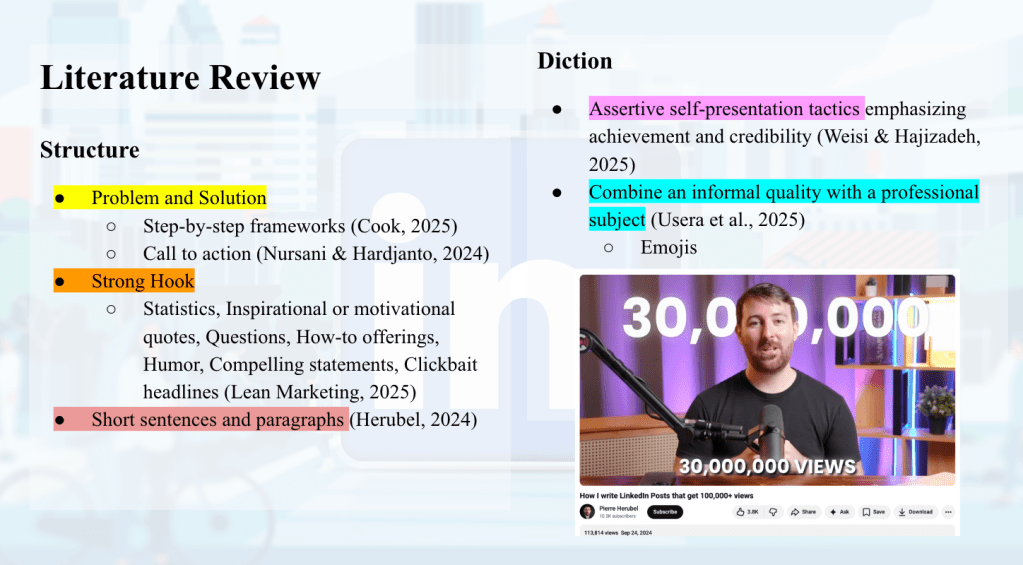
There was little-to-no research on the rhetoric of LinkedIn posts itself, which makes sense, since this is a relatively niche topic. But from the few research papers that I found and some LinkedIn post guides that I found online, such as that of Lean Marketing, I created a “formula” designed to create LinkedIn posts that would have high engagement. Here it is below:
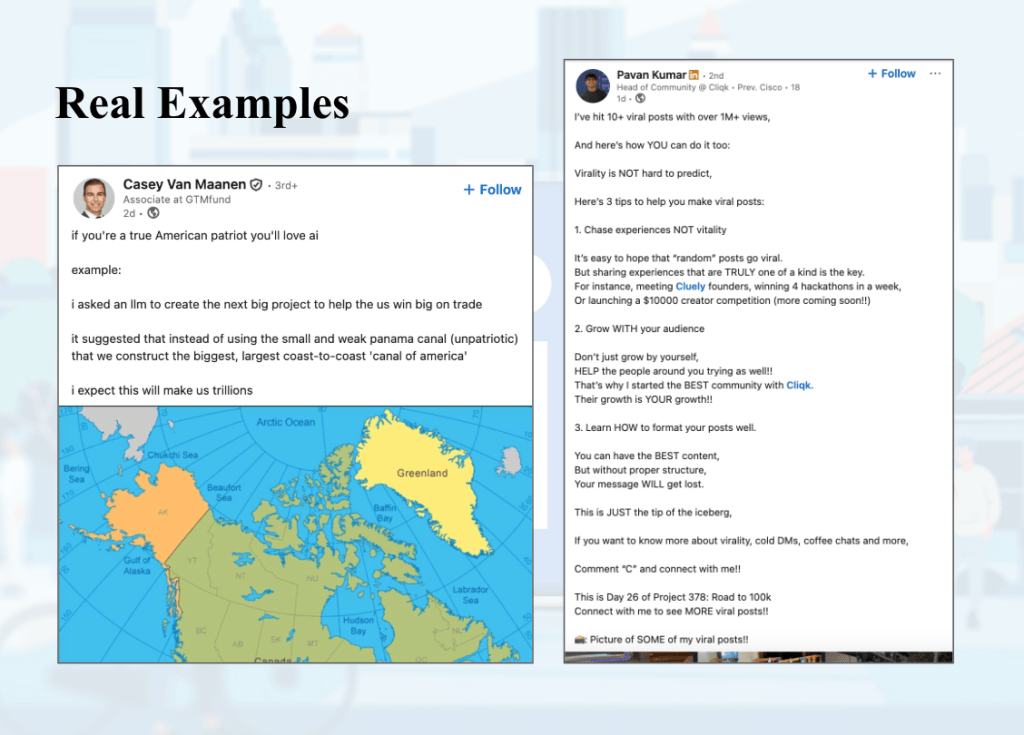
Additionally, before jumping directly into my research, I made sure to cross-check these methods on my actual LinkedIn page, to confirm that these methods were actually used in popular LinkedIn posts that I found.

You can now read part two at this link: https://megaphoneyouthregister.blog/2026/02/23/interview-with-james-chin-on-the-correlation-between-linkedin-post-rhetoric-and-youth-engagement-part-two-methods-and-results/
 The Megaphone