Author: Bryson Huang
I’m excited to interview James Chin today, on his study of the correlation between LinkedIn post rhetoric and youth-engagement! In this interview, we cover everything, from his motivations to his results, to future plans to further his work.
Q1: Please introduce yourself and your project.
Hi, I’m James Chin, and I’m a current high schooler studying how LinkedIn post rhetoric affects youth engagement. Here is my project abstract, to give you a basic introduction to my work:
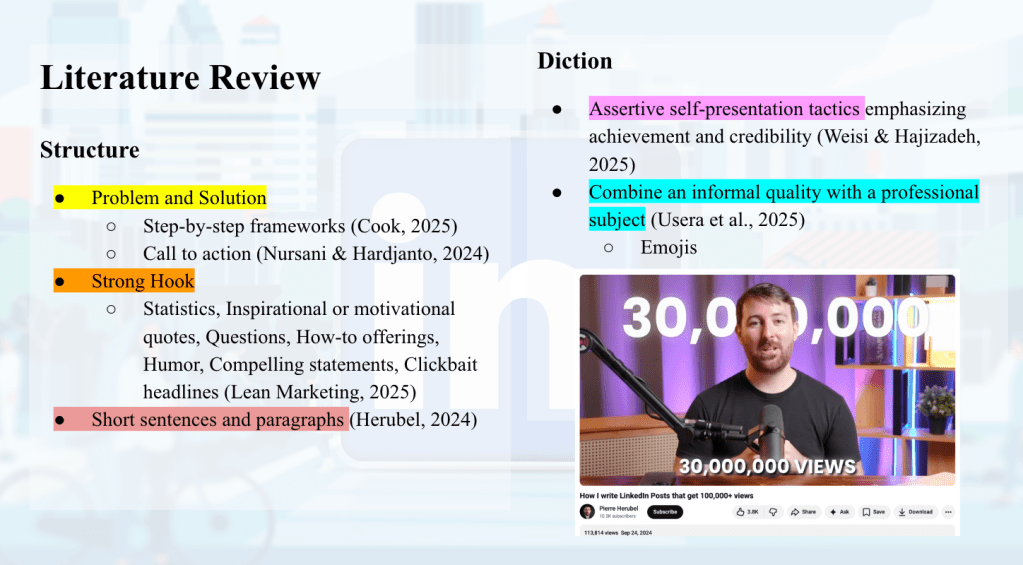
LinkedIn is the world’s largest professional networking platform, marked by career development, job searching, and business networking. As LinkedIn is increasingly employed by youth as a medium of networking, with users aged 18-24 currently making up 20.5% of total LinkedIn users worldwide as of October 2025 (Statista, 2025), a pressing question becomes: What written techniques drive the most LinkedIn-post engagement for the increasing demographic of LinkedIn users, youth? Based on these techniques advised by a literature review– problem and solution, strong hook, short sentences and paragraphs, assertive self-presentation tactics, and informality with a professional subject– I compared the success of two separate LinkedIn accounts’ posts, both on the LinkedIn platform and via a survey. In regards to the LinkedIn platform experiment, the “poster” was under a fake alias, “James Chin”, placed in the schools Basis Independent Fremont and Basis Independent Brooklyn. Their posts contained the same content, but were written differently based on the aforementioned techniques. From the experiments’ results, the listed techniques generally draw more engagement and make an individual appear more charismatic, and give them slightly more connections and credibility. It was noted that a robotic and stiff diction will draw less engagement, for sounding like “AI”. In future studies, some improvements to be made include examining other age groups’ perception of these LinkedIn posts, studying techniques individually, spending more time on the LinkedIn platform experiment, and tailoring the posts to better-fit the literature-review techniques.
Q2: What led you to first explore this topic?
I first got the idea when I was actually on LinkedIn. I was reading a couple of posts on my feed, and noticed a lot of them were more casually written than I expected, referencing memes and making use of humor to capture the engagement of my peers. Previously, my impression of LinkedIn was that it was a rigid networking platform to find jobs and build connections, but these posts completely derailed my expectations. I began becoming curious about how LinkedIn post rhetoric could be phrased to best induce the engagement of those my age.
Q3: Could you give a brief explanation of your methods, which we will cover more deeply in later questions?
Of course! So for this study, I employed two main strategies. The first was to compare post engagement on two fake LinkedIn accounts, with the posts between the two accounts written on the same topics but in a different manner. The second method was to conduct a survey that asked respondents to choose which posts they preferred, why, and to rate the two accounts on different qualities.
Q4: What informed these methods? Was there any literature that you based your post-rhetoric on?
There was little-to-no research on the rhetoric of LinkedIn posts itself, which makes sense, since this is a relatively niche topic. But from the few research papers that I found and some LinkedIn post guides that I found online, such as that of Lean Marketing, I created a “formula” designed to create LinkedIn posts that would have high engagement. Here it is below:
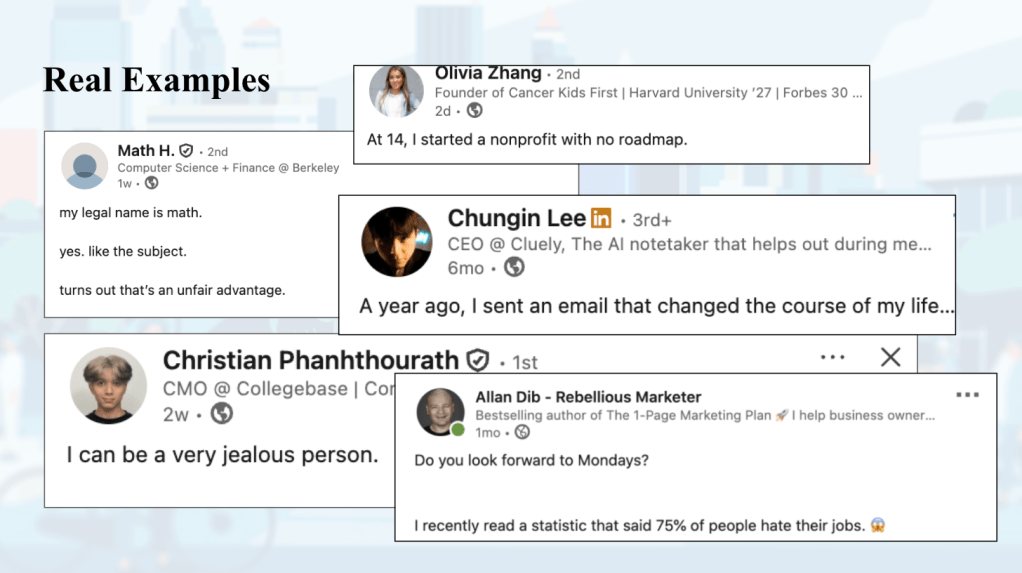
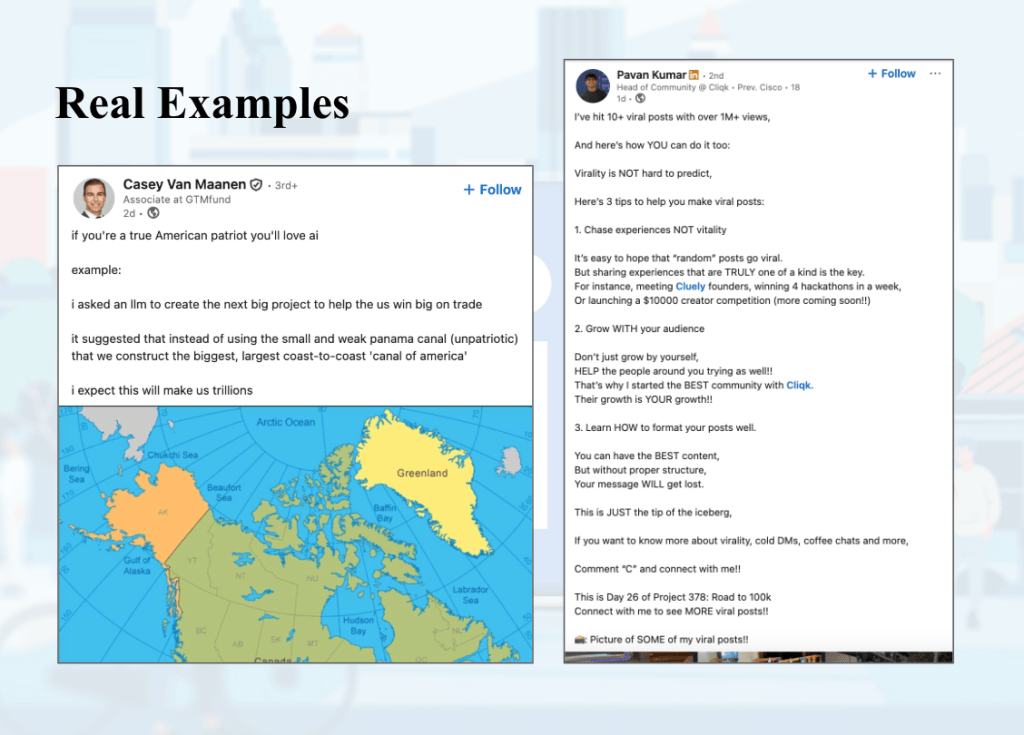
Additionally, before jumping directly into my research, I made sure to cross-check these methods on my actual LinkedIn page, to confirm that these methods were actually used in popular LinkedIn posts that I found.
Q5: Can you now give an in-depth explanation of your first procedure, where you compared the engagement of two LinkedIn accounts?
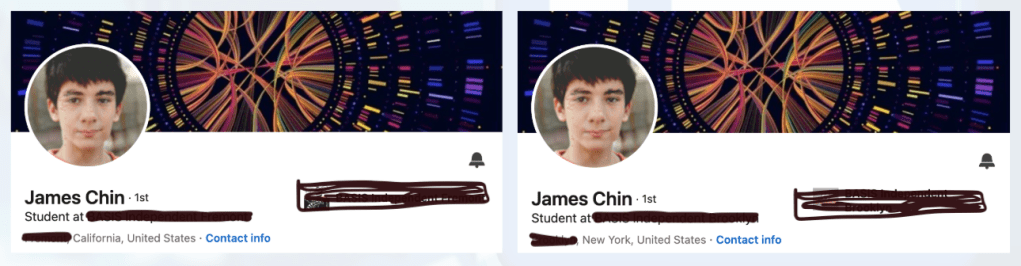
Yes! So, I created I created two LinkedIn accounts of the same person, “James Chin”.
They have identical LinkedIn profiles except their high school, to avoid others noticing that the accounts had the same name. I standardized the two profiles, giving them the same work experience to ensure that there wouldn’t be any confounding. The high schools that the two James Chin’s attend are a part of the same private education group.
Both accounts started with 44 connections from those at the same school as them. In the span of two weeks, eight posts were created and published on their accounts, with the same topic but written differently. The first James, which we will refer to as BIF James for the school he “attends”, used techniques outlined by my literature review (hook, short sentences and paragraphs, informal language, assertive tone). The second James, BIB James, applied opposite techniques (no hook, long paragraphs, formal language, non-assertive tone).
Here are the results:
BIF James
- 48 connections (44→48)
- 54 profile viewers
- 650 impressions
- 12 engagements
- 12/650 = 1.8% engagement rate per impression
BIB James
- 46 connections (44→46)
- 45 profile viewers
- 746 post impressions
- 13 engagements
- 13/746 = 1.7% engagement rate per impression
Overall, BIF James had more profile viewers and gained more connections, and there was a minute improvement in engagement rate per post impression for BIF James. But since this improvement was only 0.1% between BIF and BIB James, I decided to also conduct a survey to gain more conclusive results.
Q6: Can you explain your second procedure, the survey?
Of course! I collected 26 responses from youth aged 16-20 years old, from some of my peers and students on platforms like Reddit and Discord. These are the first half of my survey results:
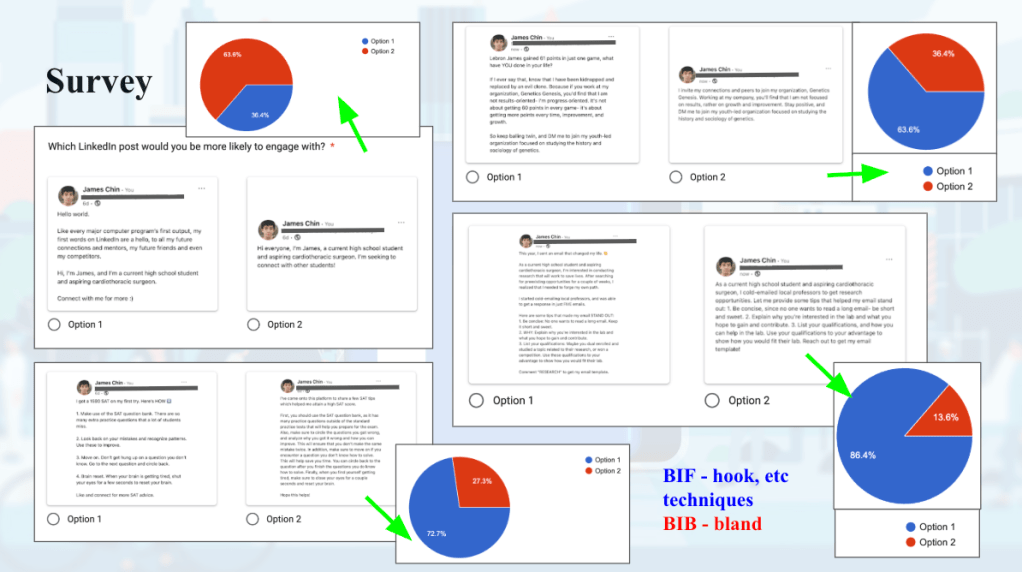
As you may notice, most preferred the posts by BIF James, which supports my literature review. However, there is one major outlier, namely the posts on the upper left corner of the slide above. For these two posts, 63.6% preferred the post created by BIB James over the post by BIF James.
I hypothesize that this outlier results from the fact that BIF James has a bit of a “robotic” diction. Although the BIF James has a unique hook in this post, I think he comes across as stiff and strange, in comparison to the introduction from BIB James, whose post leans more kind and friendly.
Overall, when asked which James seemed more credible, more charismatic, and which James they would connect with, these were the results:
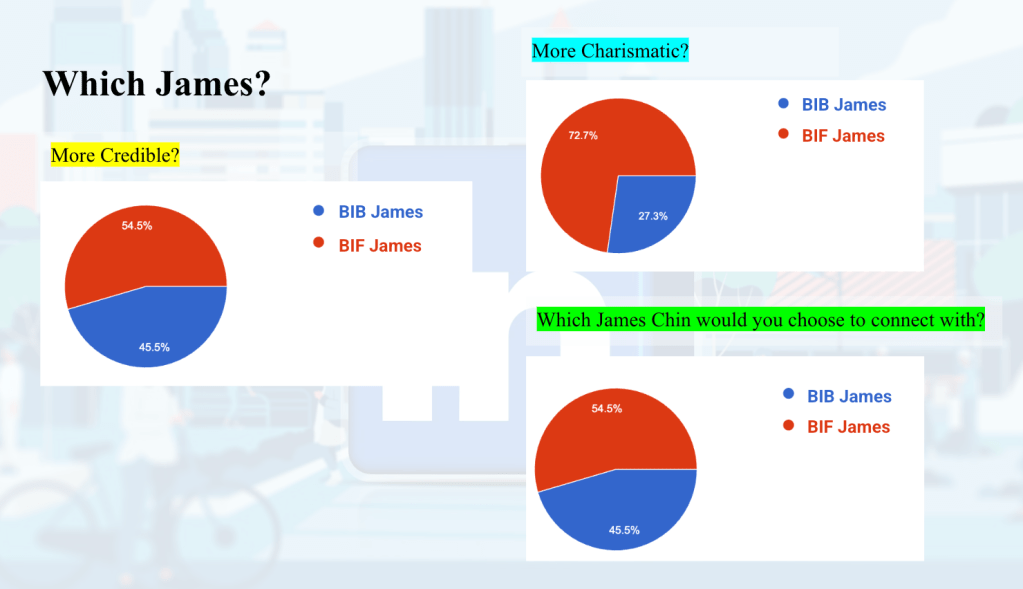
BIF James was voted to be more credible, more charismatic, and would be connected with more on LinkedIn. However, these were choices minutely in favor of BIF James for the “credible” and “connections” aspect.
From the survey, I took away the following points:
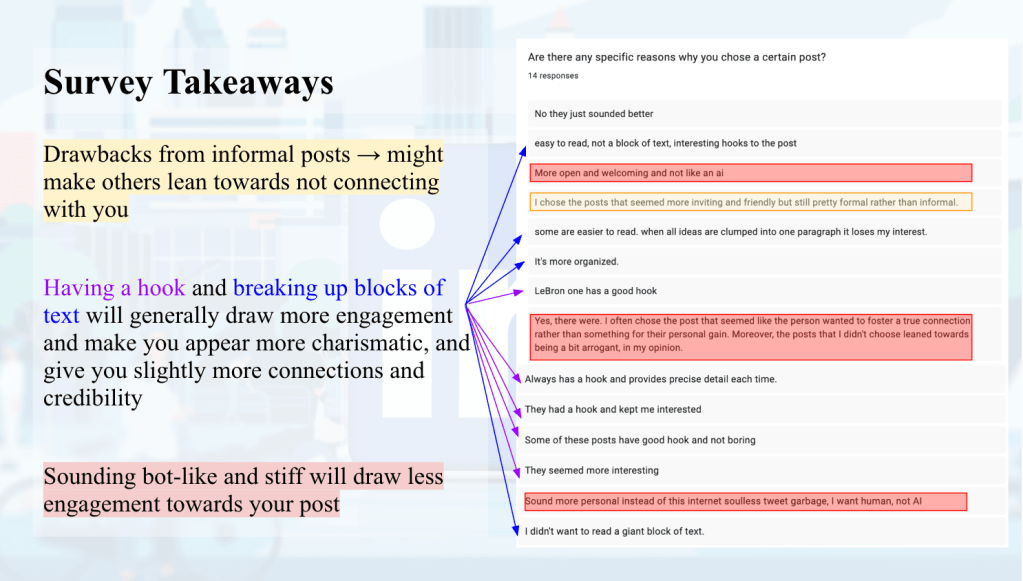
Pay attention to the highlighted text and their corresponding responses for reasoning why respondents chose a certain post.
A major drawback from the informal posts created by BIF James is that they made him only 9% more credible than BIB James. As someone writes, “I chose the posts that seemed more inviting and friendly but still pretty formal rather than informal”. Some young LinkedIn users may lean towards formality in LinkedIn posts given the connotation of the site, and having overly informal LinkedIn posts may give off the air that the poster is less “serious” or should be “taken less seriously”. Something of note to study, however, is how charisma may be correlated with engagement but not necessarily with LinkedIn connections, and how credibility is associated with LinkedIn connections. From this study, we can infer that for the purpose of engagement, creating more informal and humorous posts is advantageous, whereas for gaining more connections, it might be beneficial to engage in slightly more formal language- though BIF James was found to be “better” than BIB James in all categories (charisma, credibility, and connections), so your posts should still be relatively informal with tone.
Another huge takeaway from the survey is that having a unique hook and breaking up blocks of text is majorly advantageous for success on LinkedIn. Many mentioned these two points as a reason why they chose a certain post: “easy to read, not a block of text, interesting hooks to the post”, “when all ideas are clumped into one paragraph it loses my interest”, “They had a hook and kept me interested”. These all highlight the importance of a strong hook and short sentence structure when posting on LinkedIn.
Finally, as mentioned with the outlier analysis above, sounding bot-like and stiff will draw less engagement towards your post, with many citing that they didn’t want posts that were “like an AI”, “arrogant”, “for their personal gain”, or “internet soulless tweet garbage”.
Q7: Are there any ways you would like to expand upon your research in the future?
Yes, I think there were a couple of drawbacks in my study that I would like to improve upon in the future. For example, I would like to study other age groups’ reaction to these LinkedIn posts, and to study the techniques listed in my literature review individually (e.g. posts that are long versus short, posts with emojis versus without).
For the LinkedIn method in specific, I think one of the biggest reasons why its results were inconclusive was because of the time constraint and the limited posts that I outputted. I would like to conduct this experiment for a longer period of time and to post consistently, and to observe how my results would compare to that of my initial study. Something else that I would like to test out is to locate the James’ in a similar area, but to differentiate their names. Although there may be some name-based biases, I believe these biases would be minimal, and placing the James’ in the same location would account for location-based LinkedIn usage and engagement differences.
Thank you so much to James Chin for joining me today on this interview! I was fascinated to learn more about his research and the results of his work, and applaud him for his efforts in studying this topic!
 The Megaphone