Author: Jerry Ma
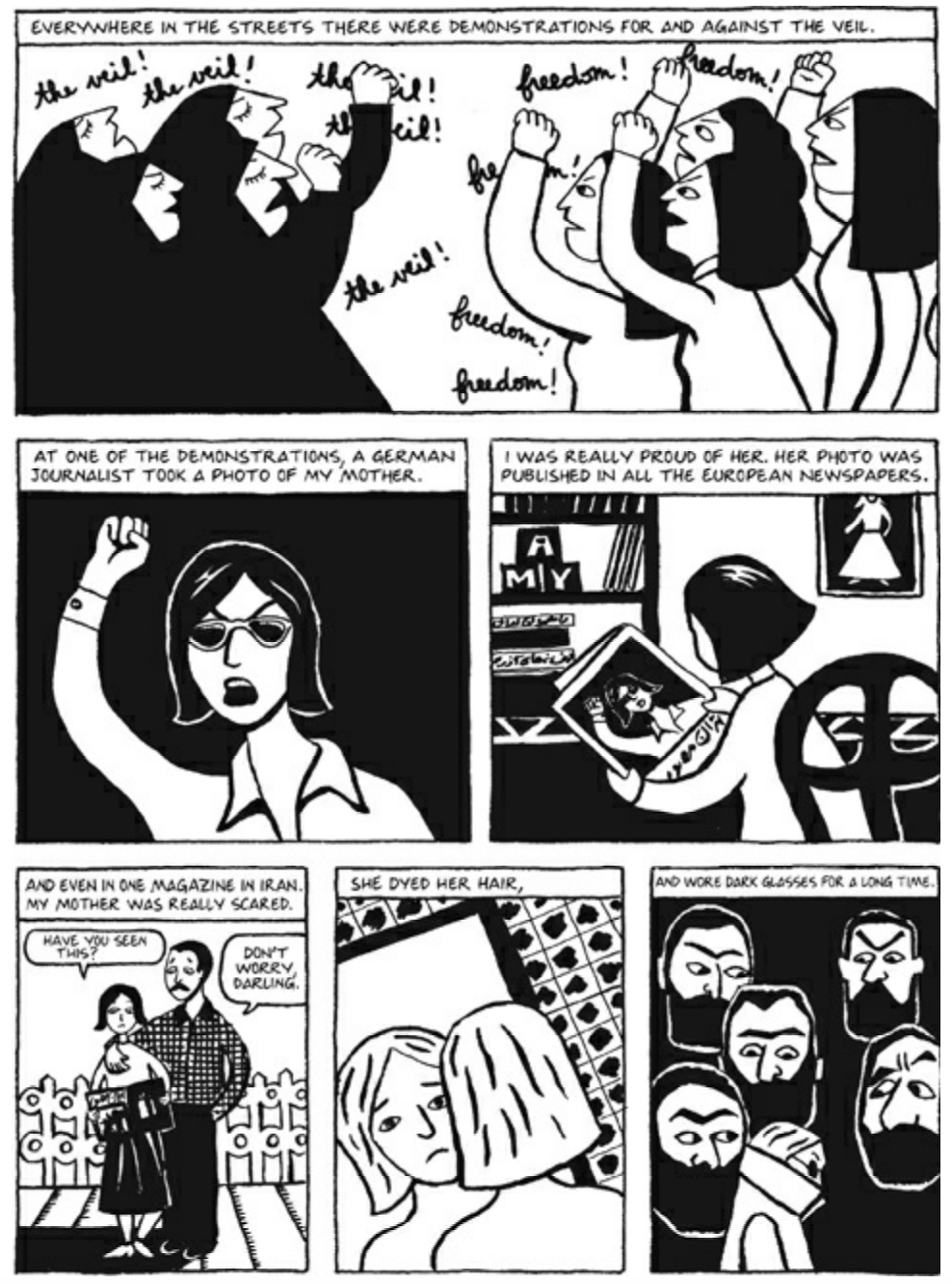
Source: Persepolis, by Marjane Satrapi.
Marjane Satrapi’s Persepolis is a retelling of her own life in Iran during and after the Islamic Revolution. She grows up in a liberal household and through the establishment of the repressive regime in Iran. Persepolis covers themes of identity, freedom, war, and loss of innocence by using images coupled with her own autobiography. The novel presents a powerful message on how political turbulence affects the lives of people, particularly women.
In this comic strip, Marjane’s mother is photographed protesting at a demonstration, and in fear, Marjane’s mother dyes her hair and wears dark glasses for a long time. Her protests come with the implementation of forced wearing of the veil by the government, reflecting the repressiveness of the Islamic Republic. In response to this policy, many, like Marjane’s mother, participate in protests for freedom and self-expression. In this scene and throughout Persepolis, Marjane expresses how her family contends with the difficulty of navigating through such a tense political landscape where her family members want to fight for their rights but fear for major repercussions and for their lives. Marjane’s mother protests against oppression, but faces incredible amounts of danger after being published in European magazines and even one Iran magazine. With this picture being printed in newspapers, Marjane’s mother runs the risk of imprisonment or even execution by their government, which causes her to hide her identity for so long. This scene represents a naiveté of both Marjane and the mainly-European newspapers publishing Marjane’s mother’s picture. They believe that Marjane’s mother’s actions are powerful and spark change, and the newspapers think that through this picture, others can be sparked into action, yet they fail to grasp the extreme consequences for Marjane’s mother. In trying to promote the idea of protesting against Iran’s repressive policies, they push protesters towards danger, which prevents others from wanting to protest. Newspaper publications such as these are double edged swords – they bring more awareness for certain causes, and yet they actively endanger those like Marjane’s mother.
 The Megaphone