Author: Jen Johnson
Huntington’s Disease
Huntington’s disease is a genetic disorder that causes nerve cells in the brain to gradually break down and die. This disorder mainly attacks parts of the brain that control voluntary movement. Those with Huntington’s disease typically display uncontrollable movement, and also face a decline in reasoning abilities. These symptoms of Huntington’s disease typically show up in those that are middle-aged. Huntington’ disease can drastically change the way a person lives and their daily life.
Figure 1
HTT Mutation
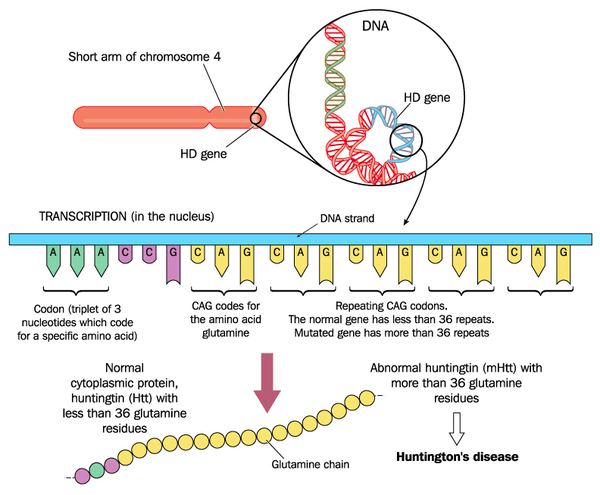
Note. Diagram depicting the HTT gene and the mutated HTT gene from “[HTT mutation]”, by MedlinePlus, 2020.
(https://medlineplus.gov/genetics/condition/huntington-disease/#causes)
Huntington’s disease is an inherited disorder, caused by mutations in the HTT gene. The HTT gene codes for a protein called huntingtin, which appears to affect neuronal and glial function. The huntingtin protein coded by the HTT protein is involved with nuclear import and transcriptional regulation, as well as apoptotic signalling and axonal transport (Yokoyama, Herculano-Houzel, Jensen, et. al, 2018). The mutation causing Huntington’s disease is in a segment of the DNA called a CAG trinucleotide repeat. This section of DNA is characterised with a series of nitrogenous bases, cytosine, adenine, and guanine, appearing multiple times in a row (Medlineplus Genetics 2020). In normal cases, the CAG segment is repeated 10-35 times, but in those afflicted with Huntington’s disease, the CAG segment is repeated in a range of 36 to more than 120 times. The increased size of the segment produces an abnormally long version of the huntingtin protein, leading the protein to be cut into smaller, toxic fragments that bind together and accumulate in neurons, disrupting the normal function of the huntingtin protein.
Huntington’s disease is an autosomal dominant disease. The Huntington’s disease variant of the HTT gene is dominant, so if one parent has 1 copy of the Huntington’s disease gene variant and the other parent has normal HTT genes, a child has a 50 percent chance of inheriting the Huntington’s disease variant and developing the disease (U.S. Department of Health and Human Services, 2023). If a child doesn’t inherit the mutation, then it will not be passed on to future generations. However, in rare cases, people without a family history develop Huntington’s disease, an occurrence called sporadic Huntington’s disease. Sporadic Huntington’s disease only makes up 3-4 percent of all reported Huntington’s disease cases.
Figure 2
Chorea
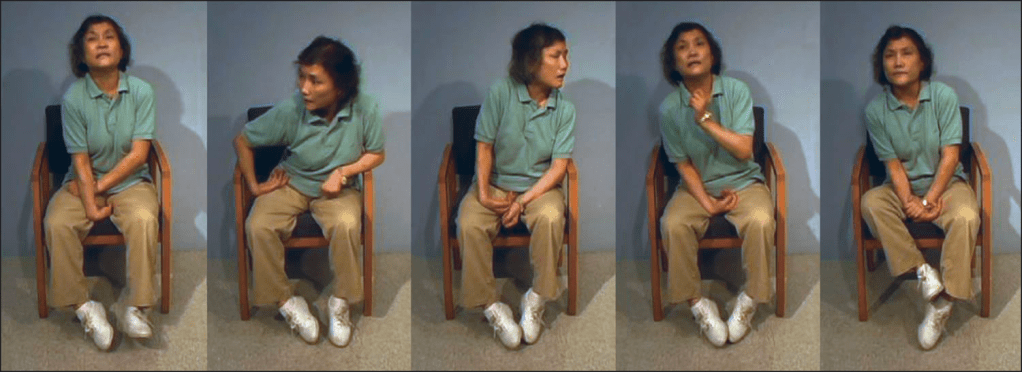
Note. Image showing chorea from “[Chorea]”, by HEALTHJADE
(https://healthjade.com/chorea/)
Those afflicted with Huntington’s disease will have chorea, a movement disorder that will cause sudden involuntary movement such as jerking or writhing. Loss of coordination in the throat muscles due to Huntington’s disease can cause difficulty in speaking and breathing and lead to changes in speech, such as slurred words, inability to control speech volume, as well as hoarseness. Another effect of Huntington’s disease is a decline in thinking and reasoning abilities, such as in memory, concentration, and judgement. Additionally, the disease leads to changes in mood, causing depression, anxiety, and irritability (Alzheimer’s Disease and Dementia). People who suffer from Huntington’s disease may constantly be irritable or angry. Huntington’s disease is commonly paired with social withdrawal and decreased engagement in social activities, possibly because of difficulty in ability to communicate as well as a feeling of disconnection from peers due to their conditions (Gibson & Springer, 2022).
Unfortunately, there is currently no treatment for Huntington’s disease (Stanford Health Care). However, doctors can lessen the symptoms of Huntington’s disease through medications. Medications such as haloperidol and tetrabenazine can be helpful for controlling the unusual movements caused by Huntington’s disease (John Hopkins Medicine, 2021). Haloperidol is an antipsychotic that can be used to improve the involuntary and uncontrollable movements caused by Huntington’s disease. Tetrabenazine is a medicine that is used to treat chorea. Additionally, because Huntington’s disease often causes depression and anxiety in those suffering from it, antidepressants and antianxiety medications can also be prescribed to those with Huntington’s disease.
Having Huntington’s disease not only puts a toll on daily life and societal connections, but also is a burden on finances. In America, average expenses for commercial patients who have Huntington’s disease is estimated to be as high as 4,947 dollars per person in the early stage. In the late stage, this price rises to about 22,582 dollars. For Medicaid patients who have Huntington’s disease, costs are about 3,257 dollars in the early stage and as much as 37,495 dollars in the late stage. The average annual cost per person around the world was 21,605 pounds, or 27,469 dollars (Jones, Busse, Quinn, et al., 2016). Costs of treatment for Huntington’s disease will increase as the severity increases.
Although the challenges that those with Huntington’s disease face are apparent, not much legislation exists relating to Huntington’s disease. A bill was introduced in the Senate by Senator Gillibrand in 2021, named the “Huntington’s Disease Disability Insurance Access Act of 2021”. This bill proposed to remove the 5-month waiting period for disability insurance benefits and waive the 24-month waiting period for Medicare eligibility for individuals with Huntington’s disease (CONGRESS.GOV, 2021). Unfortunately, the bill has not yet been passed and remains in the Senate.
Huntington’s disease can permanently change a person’s life for the worse. With the knowledge of the drastic effects of Huntington’s disease on daily life, one would hope that a more permanent cure for the disease is being created. Experts believe that with extensive research, one day there may be a cure for Huntington’s disease. There are clinical trials investigating cures for Huntington’s disease. These include therapies to modify the disease, as well as treatments to better manage the symptoms. A recent trial showed that valbenazine can improve chorea symptoms in Huntington’s disease (M. Meissner, 2023). Although not approved by the FDA yet, valbenazine has already been approved to treat tardive dyskinesia, a similar movement disorder to chorea (Byun, Lee, et al., 2022). Additionally, trials are investigating genetic techniques that can affect the overproduction of the CAG segment, such as RNA interference and gene editing.
Hopefully, medication and treatments will soon be developed to permanently cure Huntington’s disease. With a cure, symptoms associated with Huntington’s disease such as sudden, uncontrollable movements, as well as a decline in cognitive thinking and reasoning can be eliminated, and those with Huntington’s disease can live a better life. While there is no cure now, we can push for legislation that will ease the struggles of those with Huntington’s disease, and support new research aiming to develop a cure for Huntington’s disease.
Bibliography
S.868 – Huntington’s Disease Disability Insurance Access Act of 2021. CONGRESS.GOV. (2021). https://www.congress.gov/bill/117th-congress/senate-bill/868/text
U.S. Department of Health and Human Services. (2023). Huntington’s disease. National Institute of Neurological Disorders and Stroke. https://www.ninds.nih.gov/health-information/disorders/huntingtons-disease#:~:text=Huntington’s%20disease%20(HD)%20is%20an,as%20well%20as%20other%20areas.
U.S. National Library of Medicine. (2020). Huntington disease: Medlineplus Genetics. MedlinePlus. https://medlineplus.gov/genetics/condition/huntington-disease/#causes
Huntington’s disease. Alzheimer’s Disease and Dementia. (n.d.). https://www.alz.org/alzheimers-dementia/what-is-dementia/types-of-dementia/huntington-s-disease#:~:text=Huntington’s%20disease%20also%20causes%20a,and%20uncharacteristic%20anger%20and%20irritability.
Treatment for Huntington’s Disease. Stanford Health Care (SHC) – Stanford Medical Center. (n.d.). https://stanfordhealthcare.org/medical-conditions/brain-and-nerves/huntingtons-disease/treatments.html#:~:text=Currently%2C%20no%20cure%20or%20treatment,improve%20your%20quality%20of%20life.
Huntington’s disease. JHM. (2021, August 8). https://www.hopkinsmedicine.org/health/conditions-and-diseases/huntingtons-disease#:~:text=Drugs%20like%20haloperidol%2C%20tetrabenazine%2C%20and,movements%20caused%20by%20Huntington%20disease.
Jones, C., Busse, M., Quinn, L., Dawes, H., Drew, C., Kelson, M., Hood, K., Rosser, A., & Edwards, R. T. (2016). The societal cost of Huntington’s disease: are we underestimating the burden?. European journal of neurology, 23(10), 1588–1590. https://doi.org/10.1111/ene.13107
Byun, S., Lee, M., & Kim, M. (2022). Gene Therapy for Huntington’s Disease: The Final Strategy for a Cure?. Journal of movement disorders, 15(1), 15–20. https://doi.org/10.14802/jmd.21006
Gibson, J. S., & Springer, K. (2022). Social Withdrawal in Huntington’s Disease: A Scoping Review. Journal of Huntington’s disease, 11(1), 17–24. https://doi.org/10.3233/JHD-210519
Meissner, M. (2023). Expert perspectives: the future of huntington’s disease management and treatment. MedicalNewsToday.
Yokoyama, C., Herculano-Houzel, S., Jensen, F., & Morrison, J. (2018). Huntington’s Disease. In Brain Facts, A Primer On The Brain And Nervous System (pp. 103–103). chapter, BrainFacts.org.
HEALTHJADE Team. (n.d.). Image showing chorea. HEALTHJADE. Retrieved 2023, from https://healthjade.com/chorea/.
MedlinePlus. (2020a). HTT Mutation. MedlinePlus. Retrieved 2023, from https://medlineplus.gov/genetics/condition/huntington-disease/#causes.
 The Megaphone