Author: Eshwar Cherkuri
📍Las Positas College
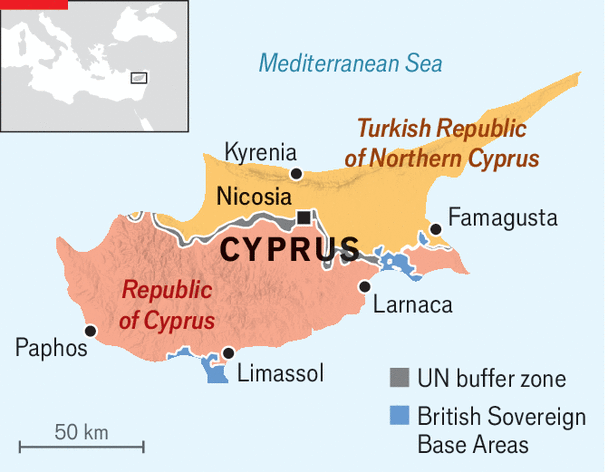
The conflict in Cyprus has spanned decades, evolving through foreign interventions, economic wars, and increasingly tense relationships between Mediterranean powers. For nearly fifty years, Cyprus remained a British crown colony until it gained independence in August 1960. However, the young nation was quickly thrust into turmoil during the 1963 crisis, known as “Bloody Christmas.” Instigated by the Turkish Resistance Union, Turkish Cypriot rebellions eventually led to the creation of the Turkish Republic of Northern Cyprus (TRNC) in the northern part of the island.
The following decades saw continued friction, as Greece became deeply involved to limit Turkey’s sphere of influence. These tensions culminated in the 1974 invasion. While Turkey was ultimately unsuccessful in gaining total regional dominance, the island remained divided. In recent years, the nature of the struggle has shifted from a purely territorial dispute to a high-stakes economic conflict, with Greece and Turkey at the forefront of the issue.
A Scramble for Resources
Today, Mediterranean powers are in a scramble to capitalize on economic opportunities in the eastern part of the sea. Gas deposits located in the waters surrounding Cyprus are driving the economic incentives of both Turkey and Greece to sustain their energy needs. As both nations are NATO members, this resource-rich region has become a point of friction that threatens the alliance’s stability.
Relations became particularly strained in 2019 when Türkiye began drilling outside the UN-agreed Turkish exclusive economic zone (EEZ), searching for resources in disputed seawaters. This led the European Union to condemn what it termed “Turkish economic aggression.” Since then, both Türkiye and Greece have attempted to divvy up the waters; Türkiye has worked with Libya, while Greece has partnered with Egypt to maximize areas for oil and natural gas extraction. Internally, these international pressures have trickled down to the local level, where Greek and Turkish Cypriots find themselves closer to the brink of violent domestic instability.
The UN’s Persistent Role
Since the 1960s, the United Nations has played a complex role in managing the crisis. Through the United Nations Peacekeeping Force in Cyprus (UNFICYP), the UN maintains a buffer zone to facilitate dialogue. Past actions include Resolution 186 (1964), which established the peacekeeping mission, and Resolution 354 (1974), which condemned the invasion. Beyond security, agencies like the UNHCR and UNDP provide healthcare and education support, while the UN actively encourages Confidence-Building Measures (CBMs)—ranging from technical committees to bicommunal workshops—to foster trust between the communities.
The Russian Perspective: A Neutral Path?
Russia has maintained a unique position throughout this conflict. Since the end of the Soviet era, Russia and Cyprus have enjoyed peaceful relations, yet the Russian Federation has remained officially neutral, refusing to side with any single group.
Moscow’s stance prioritizes direct negotiations between Greek and Turkish Cypriots under the UN Secretary-General’s “Good Offices Mission.” Russia has historically criticized unilateral actions that hinder progress, focusing instead on diplomatic solutions in the Security Council that benefit all parties involved without favoring one over the other.
Proposing a Way Forward: The Case for Concessions
In the spirit of neutrality, a sustainable solution likely lies away from the popular “two-state plan,” which would require the Republic of Cyprus to formally surrender territory. Instead, a path forward could revolve around mutual concessions. This would involve:
- Sovereignty and Security: Both Greece and Türkiye must respect the borders and economic sphere of the Republic of Cyprus to halt aggressive advances in the Mediterranean.
- Demilitarization: Türkiye, which maintains a significant military presence, would gradually demilitarize the UN-defined borders of the Republic of Cyprus.
- Political Power-Sharing: Addressing the lack of political representation for Greek Cypriots within federal institutions to ensure equitable governance.
- Confidence-Building: Engaging Turkish Cypriots through the reconsideration of the TRNC’s status and returning areas of historical significance—such as the city of Famagusta—as an “olive branch” to build trust.
The Diplomacy of Confidence
The argument for focusing on CBMs is rooted in history. Similar diplomacy was a key factor in stabilizing Western Europe following World War II. Treaties like the Treaty of Rome and the Elysee Treaty allowed former enemies to reconcile through gradual economic and political steps. In Cyprus, where there are fewer parties involved, this “step-by-step” approach could yield even quicker results.
However, critics argue that past CBM efforts have shown little effect and that demanding Turkish demilitarization is perceived as one-sided. Some suggest that only a two-state plan provides the autonomy both sides crave over their own laws and borders.
Despite these critiques, the delicate nature of the Mediterranean today suggests that any rash decision could lead to a dangerous escalation. A two-state plan could set a troubling global precedent, potentially destabilizing other regions with similar disputes. In this context, extending an olive branch through gradual diplomacy remains the most viable long-term solution to end a conflict that has remained frozen for far too long.
 The Megaphone