Author: Ecila Carpin, Orion High School
📍Yerba Buena, CA
Between 1750 and 1850, Europe and the Americas endured several revolutions that transformed politics and social life. The Enlightenment brought about revolutionary ideologies of liberty, equality, and popular sovereignty that inspired the American Revolution), the French Revolution, and the Latin American revolutions. In this way, these movements overturned monarchies, colonial powers, and rigid hierarchies. Where such revolutions did occur, they typically dismantled political institutions, such as monarchies and colonial administrations. However, the realization of social change was nonetheless constrained by the continuing class, racial, and gender inequalities. Although the revolutions in Europe and the Americas between 1750 and 1850 led to transformative political changes by overthrowing monarchies and colonial rule, they were less effective in altering deeply ingrained social hierarchies, which persisted in both regions.
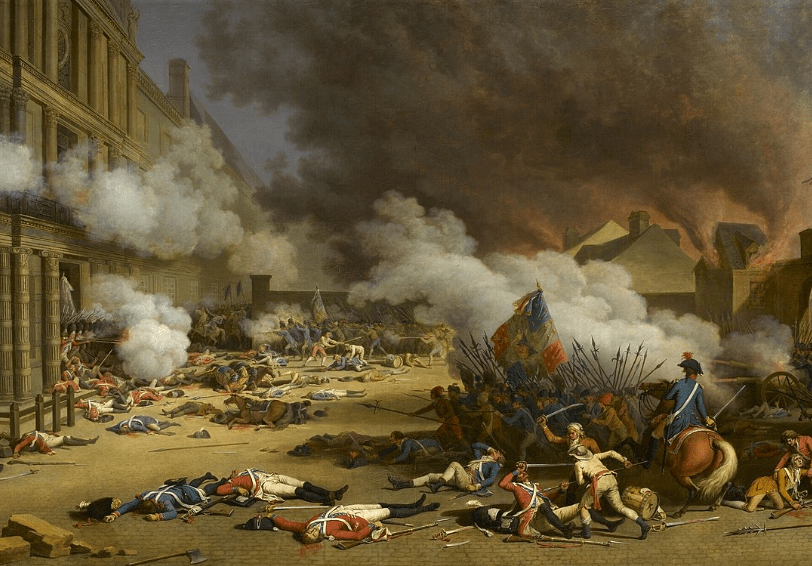
The revolutions of 1750–1850 led to significant political changes, especially in the abolition of monarchies and the establishment of new republican governments in Europe and the Americas. The French Revolution abolished the monarchy in 1792, substituting it with the First French Republic. Leaders of the Revolution, such as Robespierre, supported ideas such as popular sovereignty, influenced by Enlightened thinkers like Montesquieu, including the rights of people without privileges and the people governing through institutions such as the National Convention (Strayer & Nelson 349). The end of the monarchy in the French Revolution signaled a radical departure from centuries of absolute rule inspired at least in part by Enlightenment notions of liberty and equality. However, due to having bad leadership and restricting individual freedoms without the clear enforcement of an impartial constitution, the period of the French Revolution was known as the Reign of Terror. the later rise of such authoritarian figures as Napoleon Bonaparte showed the fragility of such changes since the revolutionary fervor often degenerated into centralized power and thus limited the long-term democratization of French governance. A painting showing the execution of Robspierre showed the clear instability of the Revolutionary government by the French as members of the government lived in fear due to even them being constricted on what they can say (Musee Carnavelet, 354). This painting was meant to display the public tension and tension within the Revolutionary government because Robspierre who was essentially the leader of the Revolution was being killed due to his extreme policies of murder and authoritative control. Although the French Revolution was supposed to give the “common” man more rights and economic progress, the new government restricted their rights and did not do much to address the key economic disparities faced by most of the
population. From 1791 to 1804, the Haitian Revolution overthrew French colonial power, but it also abolished slavery and established Haiti as the world’s first independent nation governed by freed slaves (Strayer & Nelson 357). The terrible conditions of plantation slavery fueled this movement, which was inspired by Enlightenment concepts. The Haitian Revolution shows the period’s extreme political possibilities by enslaved Africans not only rejected colonial oppression but also established a government that challenged racial hierarchies. However, international isolation and punishing economic sanctions imposed by global powers like France messed with Haiti’s capacity to consolidate and sustain its revolutionary victories, highlighting the external restrictions on political reform in post-revolutionary governments. A picture showing the hanging of a French soldier by Haitian slaves shows the violent and race-driven battle for independence by the Haitians (Marcus Rainsford, 359).. This picture shows how specifically slaves with darker skin tones like the ones in the picture find a need to fight against their oppressor with lighter skin, showing the division and polarization of groups of people based on skin tone. The revolution caused polarization between the Europeans and Haiti putting them in a trade deficit since the Europeans didn’t want to seem weak trading with a country consisting mostly of slaves. The revolutionary movements led by Simón Bolívar and José de San Martín were successful in having the Spanish and Portuguese colonial structures overthrown and instituting independent republics throughout Latin America (Strayer & Nelson 351). Bolívar allowed his ambition to create a unified South American state governed by constitutional republics to be guided by Enlightenment ideals. The Latin American revolutions destroyed the colonial systems and ended European rule but also often just replaced one elite-dominated political structure with another. In many cases, Creole elites quickly seized power, sidelining indigenous and mixed-race populations and refusing to address systemic inequalities. This demonstrates how revolutionary political change was often limited by the persistence of pre-existing hierarchies. Although the revolutions of this period succeeded in overturning monarchies and colonial rule, the resulting political systems often struggled to realize the full scope of Enlightenment ideals, with power frequently being consolidated among new elites.
While revolutions dismantled elitist political regimes, they were less effective in altering deeply rooted social hierarchies, like class, racial hierarchies, and gender inequalities which often persisted in both Europe and the Americas. In France, the abolition of feudal privileges and the Declaration of the Rights of Man and Citizen seemed to indicate great strides toward equality (Strayer & Nelson 353). Power shifted primarily to the bourgeoisie, while the lower classes continued to suffer under economic hardship. Women, despite their huge contributions to the revolution, were denied political rights under laws such as the Napoleonic Code. Where the Revolution had overturned hereditary privileges and feudal oppressions, emphasis on legal rather than economic equality meant that wealth and power stayed within the hands of the few elite folk. Also, women were limited from political expression with blatant denial of the revolutionary rights of equality which shows how incomplete social revolutions could be with the hypocrisy of giving equality to the commoners but still discriminating a major part of the population.
Similarly, in the newly independent lands of Latin America, creole elites dominated the new governments and left little room for political representation of indigenous peoples, Africans, and mestizos (Strayer & Nelson 360). The socially hierarchical systems of racial and class-based divisions established under colonial rule were maintained through elite control of land and wealth. The revolutions within Latin America largely preserved, in social terms, the systems that favored elites. In failing to address either land redistribution or indigenous rights, these movements showed the continuation of inequality as a product of political change without social reform. The painting depicts Simone Bolivar coming back to his hometown but realizing that the people still suffer with rivalries with other Latin American countries on land while not having an improved quality of life (Anonymous, 362). This painting’s purpose is meant to highlight how although independence movements like the one in Latin America were successful, due to a lack of unity and division the political regime remained unstable and the revolutionary war was replaced with other domestic conflicts without any benefit for the people fighting. While the American Revolution established a republic based upon Enlightenment ideals of liberty and equality, slavery remained legal, most importantly in southern states. Enslaved people were denied the freedom that the Declaration of Independence enunciated, and racial inequality was institutionalized (Strayer & Nelson 351). The revolutionary ideals that went along with the continuation of slavery show the contradictions within the American Revolution. While political independence was won, the continuation of racial oppression shows the limited nature of the revolution’s impact on social transformations. Often, revolutions had destroyed political systems but failed to institute real social change, as current hierarchies of class, race, and gender very often remained resilient.
Lastly, efforts to reverse or contain revolutionary changes further limited the extent of social and political transformation during this period. After Napoleon’s defeat, the Congress of Vienna wanted to restore the pre-revolutionary political order by reinstating monarchies and suppressing nationalist and liberal movements (Strayer and Nelson 355). This movement was led by conservative figures like Prince Metternich, and the Congress which established the Concert of Europe to prevent future revolutions. The Congress of Vienna showed active opposition to revolutionary changes since the conservatives favored stability rather than reform. This brief Congress was able to successfully restore the monarchies. However, failure or unwillingness to respond to popular demands for political representation coupled with social reforms intensified further revolutionary pressures. Most Latin American nations saw, after the process of independence, the re-establishment of the dominance of the Creole elite. The reliance of Simón Bolívar on alliances with the elites shut out Indians and mestizos from influential positions (Strayer & Nelson 361). The resurgence of Creole supremacy shows a limitation in revolutionary change throughout Latin America. Though the colonial rulers were removed and new governments came, in many ways, they perpetuated several of the same social and economic
inequalities against the greater pledge of independence taken. The revolutions in 1848 that spread through Europe in the idea of a liberal constitution and broadened political rights were successfully suppressed by conservative reactionary forces such as the monarchy suppressed it (Strayer and Nelson 363). While greatly provocative in their appeal for reform, these nearly simultaneous uprisings were unable to overthrow solid power. The defeat of the 1848 revolutions shows how strong the old elites were and the limitation of revolutionary forces. The cries for change were attempted everywhere, but the conservative regime successfully reestablished control, putting a check on the political and social changes that revolutionaries hoped to see.
Revolutions in Europe and the Americas between 1750 and 1850 created significant political changes by overthrowing monarchies, dismantling colonial systems, and establishing new republics. However, their impact on social structures was more limited, as engrained hierarchies based on class, race, and gender often persisted despite the ideals of equality and liberty. This dynamic reflects a broader historical pattern where revolutionary movements often achieve political transformation more easily than social reform. For example, during the transition from the postclassical to the early modern period, events such as the Protestant Reformation dismantled the Catholic Church’s monopoly on religious authority, but social and economic inequalities, such as serfdom in Europe, remained largely intact. This is because even though revolutions are meant to create ever-lasting change people often do not focus on unifying to ensure that actual change is brought upon as they focus on overthrowing the previous corrupt power.
 The Megaphone