Author: Hannah Lee, Franklin High School
📍Portland, OR
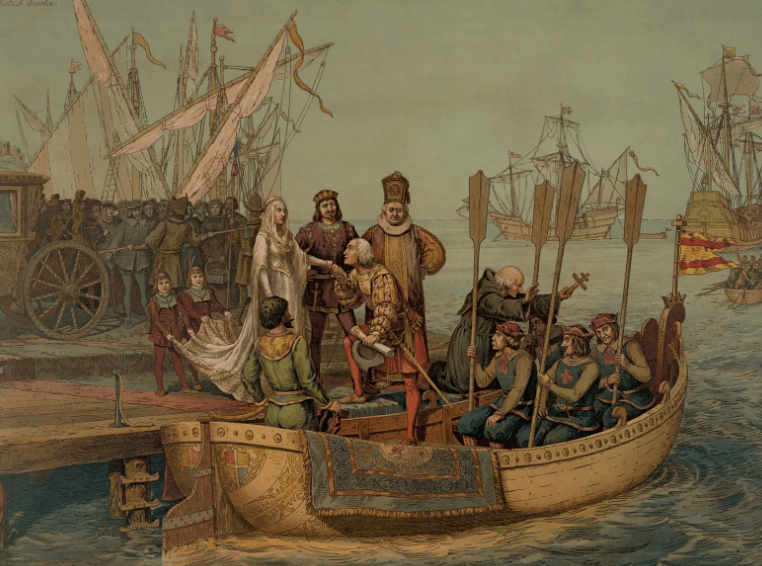
From the 16th through 18th century, European empires had transformed the social and economic systems of the New World. Starting off with Christopher Colombus stumbling upon a new continent while trying to find a route to India, to an expansion of the European empire of a Mercantalist relationship with its colonies in the Americas. The inhabitants of the New World lacked technological capabilities of the Europeans and the ability to resist their control due to them dying off disease and being unable to defend themselves against the Europeans. European control significantly changed the new world as it imposed racial and social distinctions while also altering indigenous cultures and traditions. As European powers wanted to economically benefit of these colonies, they implemented new economic and social systems that changed the americas by exploiting the indigenous people and perpetuating unequal socialstandards. The European Empires of this time significantly changed the New World by instituting social hierarchies within the colonies, instituting new political systems, and also increasing the economic dependence of mercantalism in world-wide trading.
European empires changed social hierarchies in the New World, imposing European values, and racial classifications that drastically altered indigenous societies while solidifying European dominance. The Spanish Hacienda System emerged to control land and labor in the New World, especially in regions like Mexico and Peru. Under this system, indigenous people were required to work on large estates, producing goods and while paying tribute to their Spanish masters. With indigenous populations forced to live in settlements near haciendas, this labor system allowed Spanish landowners to exploit native labor while also enforcing cultural assimilation (Strayer and Nelson 211). The hacienda system was a major change from indigenous communal land practices, forcing Native Americans into a labor tool for a European economy that needed raw resources. By controlling native labor, the Hacienda system created a system that perpetuated long-lasting social inequality and changed native lifcestyles to fit the Spanish empires economic demands. In the Spanish colonies, a very strict caste system was developed for placing the Spanish, Indians, and slaves into their proper racial and ethnic categories (Stayer and Nelson 212). Europeans were at the very top of the pyramid as either peninsulares or creoles who usually owned land and controlled the lower classes. Next in line came the mestizos who were half European, half indigenous while the furthest down the system were for the indigenous and African populations who usually were the labor force for the economy. This racial hierarchy was largely dependent on social mobility and embedded racial discrimination within the colonial system. This supported white supremacy through the casta system in which it would be very difficult for indigenous or African persons to realize any significant position of economic or social power. The Spanish colonization changed the New World through instituting racial discrimination that changed social structures even after colonial rule had ended, by continuing to discriminate people in society using their skin color or origin. Missionaries in Spanish lands actively worked on the conversion of indigenous people into Catholicism through forceful abandonment of their traditional religions and cultural practices (Strayer and Nelson, 83). Most indigenous peoples were coerced to accept Christianity and ways of European life, disrupting their social structures even further and minimizing the influence of indigenous belief and practice. The forced conversion of indigenous populations made for a significant cultural shift in the Americas, where European religious values fully supressed indigenous spiritual practices. This social restructuring would take the cultural identity away from the indigenous communities, but also reinforce the cultural superiority of Europeans. Some people spoke out against the harsh treatment of indigenous people including a handful of church leaders like Bartolome de Las Casas, who called for the protection of native populations from exploitation. In the letter he wrote to the King of Spain (Philip the V) he stated that the harsh conditions would kill the natives and prevent them from converting to Catholicism (Bartolome de Las Casas). This was to expose the cruelty of the Spanish treatment of indigenous populations and initiate reforms. His perspective as a Spanish missionary reflects his belief that Christian values should lead to a more humane treatment of native people.
Political systems in the New World replaced Indigenous government based on communal and tribal values with European authority of forced labor and hierarchical working classes, which would limit the autonomy of the native people inhabiting the land but increase the power of the Spanish government through the resources they acquire from exploitation. The Encomienda system was one of the early colonial practices where Spanish authorities allowed settlers the “privilege” of collecting from the native communities labor and tribute (Strayer and Nelson, 210). Even as the Spanish crown tried to make it seem as an effort to “civilize” and convert the natives into Catholicism, the encomienda system was basically slavery, putting natives under harsh working conditions within mines and fields. The encomienda system was a way political reordering of the Americas took place, since every independently governed indigenous community was substituted by a labor authoritarian system with the forced exploitation of the Natives. This system allowed Spanish authorities to centralize political power and gain the wealth of the Americas at the cost of indigenous freedom. Joint-stock companies and rich businessmen were the main way of how the British obtained control over their North American colonies, which was different from the hierarchical control like the Spanish. These companies were granted royal charters and had autonomy in local government of their colonial land (Strayer and Nelson, 218). Local political organizations were set up in colonies like Virginia like the House of Burgesses with a representative government of white males. In the French North America, Native American leaders and the French were able to negotiate and peacefully trade beaver fur ( Strayer and Nelson, 264). The French had a cooperative relationship with the Native americans, allowing them a certain amount of political influence while also benefiting mutually from the trade.
European colonization of the New World also changed the economic system of the Americas by including it in the global trade networks and transforming the raw resources of america into key methods to increase the economic status of the European powers conquering the Americas. Silver mining was highly important and also how the Spanish was the main exporter of silver to the rest of the world mainly to west China and Europe (Strayer and Nelson 259). This massive silver importation made Spain assert itself to be the main supplier of silver from the colonies, but mining required forced labor, resulting in the victimization and death of a huge number of indigenous laborers through harsh conditions. The silver trade showed the mercantalist nature of colonization by the draining of the New Worlds resources in order to support the economies of Europe and Asia and creating a dependency on the Americas to accomplish this. This forced labor aspect of silver mining, in addition, was one of the main factors in the consolidation of the labor practices that were mainly detrimental to the health and the economic well-being of the indigenous communities while benefiting the European settlers.In a colonial period painting of the Potosí mines, the inhumane work conditions that workers had to bear are illustrated, working with toxic mercury and enduring a lot of hard time (Anonymous, 260). The purpose was to illustrate the importance of the Potosí silver mines in the colonial wealth but it also highlights the very brutal conditions of the laborers. The historical background is the massive economic change characterized by the silver trade as Ming China switched from paper currency to silver. The extraction was the harsh which led to the enrichment of Europe, while the native populations along with their health were being treated badly. This could also be represented by the red hills of the silver mines symbolizing the death of the native population. The New World was part of a global trading scale which was trading a variety of crops, animals, and diseases from the Old World to the New. European cattle and hoses transformed farming in the Americas while crops like sugarcane, tobacco, and potato changed European staple diet (Strayer and Nelson, 208). Even though there were positive benefits, the Columbian Exchange changed indigenous agricultural practices and economies, replacing them with systems focused on exporting cash crops for European profit. “Every kind of merchandise such as can be met with in every land is for sale there, whether of food and victuals, or ornaments of gold and silver,or lead, brass, copper, tin, precious stones, bones, shells, snails and feathers.” (Hernan Cortes, 136). This shows the complex economy of the Aztecs before European conquest and how the potential wealth that the Spanish could acquire drove them to later conquer the empire. The historical context of Cortés’s observations shows the motivations for Spain’s interest in conquering and exploiting the Americas for economic gain (gold). The fur trade in North America shows how indigenous economies were integrated so French traders could gain a steady supply of furs, which were then exported to Europe. This trade dependency changed native economic structures, increasingly tying them to European markets.
The arrival of European empires in the New World drastically changed the social, political, and economic systems of the Americas, as indigenous structures were dismantled and replaced with European-controlled social hierarchies and labor systems. Through exploitative practices such as the encomienda, hacienda, and plantation systems, European empires perpetuated racial hierarchies and economic dependency that favored European wealth while devastating local native populations. The dependency created by the Colombian exchange will eventually led to the Irish famine as they greatly depended on crops and food staples from the Americas and when the crop wasn’t able to grow due to disease the Irish greatly suffered. Social structures based on race continued their legacy to the present day as the term white was established as “superior” in the past so that Europeans could assert dominance over the slaves and dehumanize them due to their different skin color.
 The Megaphone