Author: Vrinda Iyengar
This past week, years of poor economic conditions for young people in Nepal culminated in an almost 4-day long protest, led mostly by the Gen-Z population of Nepal, taking the entire country by storm.
The immediate cause of the protests was a “social media ban” imposed on September 4th, 2025, which banned Facebook, Instagram, Youtube, Linkedin and 22 other social media platforms in Nepal because these platforms failed to comply with the country’s registration requirements. The ban, which according to the Nepali government, was an effort to “curb online hate, fake news, and cybercrime,” angered many young people in Nepal, who viewed the bill as authoritative and non-democratic. The move was also widely criticized by rights’ groups and called a tool for censorship. In an interview with Al Jazeera, Bhola Nath Dhungana, the president of Digital Rights Nepal said, “It is not wrong to regulate social media, but we first need to have the legal infrastructure to enforce it. A sudden closure like this is controlling.”
Weeks before the trend, a “nepo kid” trend had spread on social media, which highlighted the lavish lifestyles of children of politicians. This was especially frustrating to the young people of Nepal, who have suffered terrible economic conditions and poor job availability. In 2024, Nepal’s unemployment rate was 10.8%, the second highest in South Asia, and the youth unemployment rate was over 20%. As of a May 2023 report, 46.7% of Nepal’s population was under 24 years of age, the age group for which economic conditions are especially poor. In addition, according to the World Bank 33% of the country’s GDP in 2024 came from remittances sent by friends/family members living abroad. Most young people cite corruption in the government and mismanagement of public funds as the reasons for these poor conditions, and the anger over years of corruption culminated in large protests after the enforcement of the “social media ban.”
The protests began on September 8th, when tens of thousands of young people came out to protest corruption and nepotism. Protestors stormed the parliament in Kathmandu, Nepal’s capital city. At the site, interviews with protestors reflected how the social media ban was not the singular cause of these protests, rather it was a reaction to many years of corruption and poor economic conditions. In an interview with the BBC, one protestor Sabana Budathoki, stated, “Rather than [the] social media ban, I think everyone’s focus is on corruption… We want our country back. We came to stop corruption.” At this protest, police fired water cannons and rubber bullets at and used batons in an attempt to violently subdue protestors. As a result, 19 protestors passed away and many more were injured on September 8th’s protest.
The violence on September 8th sparked much outrage. Home minister Ramesh Lekhak submitted his resignation that evening following intense criticism over his use of force.
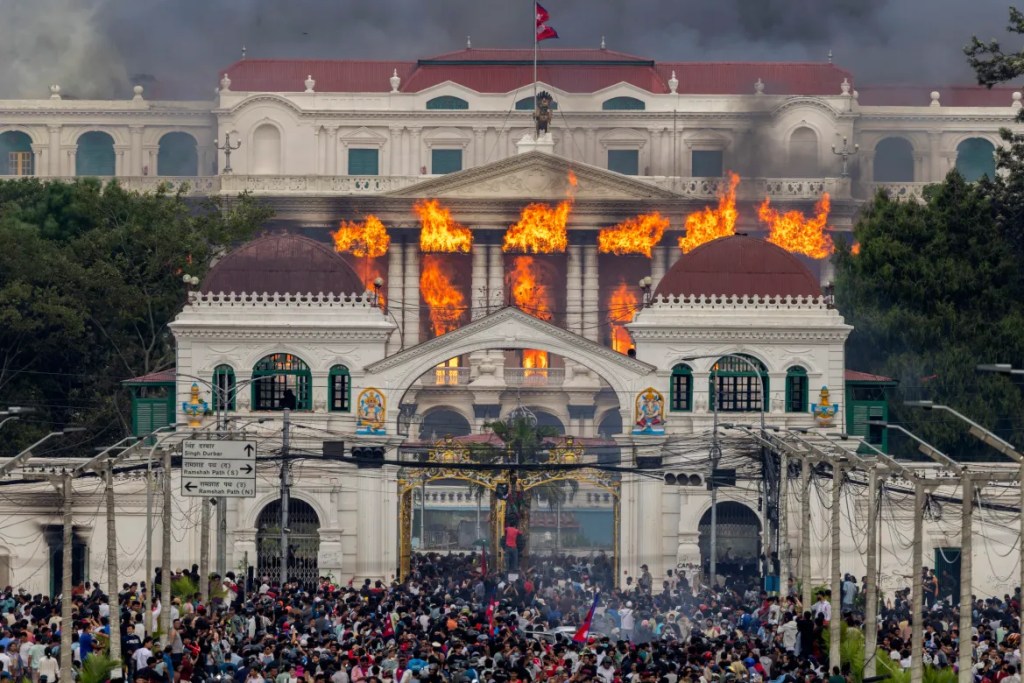
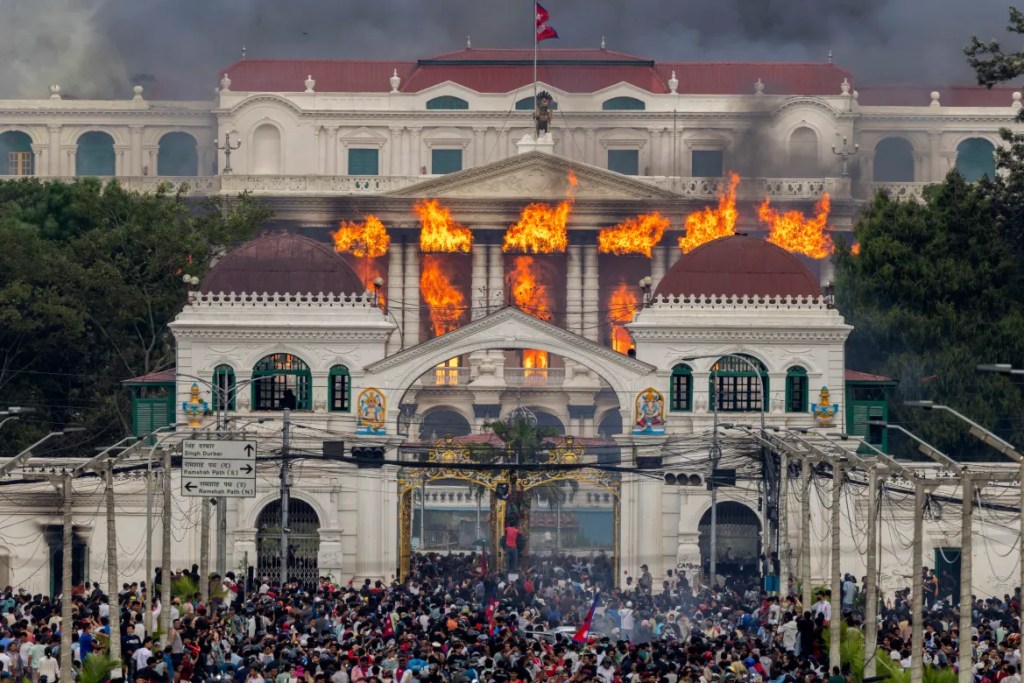
On the morning of September 9th, Nepal’s government officially lifted the social media ban. This decision came after government officials held an “emergency meeting” to discuss the concerns of the youth protestors the previous evening. However, this move did little to contain the protests, which intensified as protestors set fire to the parliament in Kathmandu. Government buildings and the houses of political leaders were also attacked around the country.
In the midst of the protests on September 9th, Prime Minister Khadga Prasad Sharma Oli, commonly known as K.P. Oli, resigned. K.P. Oli is the head of the communist party in Nepal and is disliked by many in Nepal for his hostility towards critics and the media, and for facilitating nepotism and corruption in the government. One such scandal was the Fake Bhutanese Refugee scam, where a task force appointed by Prime Minister Oli tasked with sending remaining Bhutanese Refugees to the United States forged documents which added Nepalese citizens to the list. The government officials collected millions of rupees from over 800 Nepali citizens who were told the forged documents would allow them to emigrate to the United States, when this was not the case. According to Al Jazeera, 48-hours before he resigned, he was quoted mocking the protestors, saying, “By calling themselves the “Gen Z” the protesters seemed to believe they could demand whatever they wanted.”
Three more protestor deaths were reported on September 9th and K.P. Oli’s house was also set on fire. According to reports from jail officials, amid the chaos of the protests, some 900 inmates managed to escape from two prisons in Nepal’s Western districts. On the night of September 9th, in an attempt to control the protests, Nepal’s army chief released a statement announcing the imposition of a curfew, which also said that if unrest continued, ‘”all security institutions, including the Nepal Army, are committed to taking control of the situation,” without detailing what this “taking control” might entail. He also urged protestors to halt demonstrations to ensure peace and prevent further loss of life and come forward to engage in dialogue.
The protests continued on September 10th as tens of thousands of protestors remained in the streets even late into the day. Both the Hilton Hotel and the Health Ministry Building were set on fire.
On September 12th, the country began to return to a pre-protest state after Supreme Court Justice Sushila Karki was appointed as the interim Prime Minister of Nepal. She was specifically nominated by many young protestors over Discord for her anti-corruption stances. Karki is the first woman to head Nepal’s government. After a relatively calm weekend, on September 15th, Karki appointed three new ministers, also well-liked by the public for their commitment to public causes and the public interest.
This situation falls in-line with recent trends in South Asia. Like in Nepal, other South Asian countries like India, Bangladesh, Pakistan and Sri Lanka have faced decreasing digital freedoms due to internet shutdowns and restrictive laws. For example, in 2024, India saw 84 recorded internet shutdowns, the highest for any democratic government, and Bangladesh used internet shutdowns to crack down on student-led protests. In 2025, Pakistan amended its cybercrime law, the Prevention of Electronic Crimes Act (PECA), to criminalize the spread of “fake or false information”. The vague language in this law allows for criminal offenses punishable by up to three years in prison and has been condemned by human rights groups like Amnesty International. Similarly, South Asia has one of the fastest growing populations in the world, and a large percentage of the population in South Asia is under 25, who have largely used social media platforms like Twitter, Facebook, etc to push back against their oppressive governments. In an area where the fairness of supposedly democratic elections is often called into question due to corrupt and authoritative tactics, like the social media bans mentioned above, censorship, political violence, etc, the recent wave of political action targeting these issues by young people has the potential to bring about real and permanent change to the region.
 The Megaphone