Author: V. Iyengar, Silicon Valley Chapter
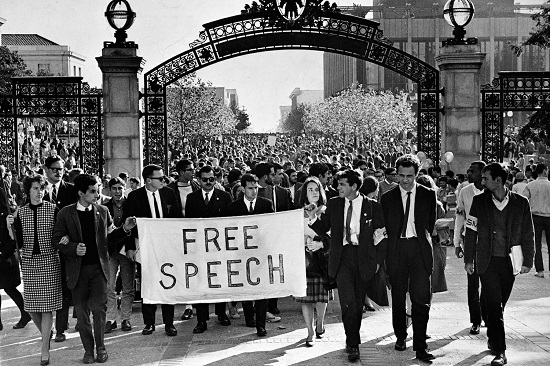
The history of the Bay Area has always had strong ties to protest movements. Most well-known of these include the 1960s free-speech and anti-war protests, the Black Power movement of the Civil Rights Era, AIDS activism in the 1980s, and more. One of the most effective and widespread mediums for protest, not only in the Bay Area, but all over the world, has been music, and in this article, we will explore music tied to protest movements in the Bay Area, and how this medium has changed over time.
Free-Speech and Anti-War Protests
One of the biggest and most well-known protest movements in the Bay Area took place in the 1960s at the University of California, Berkeley. This protest is known as the Free Speech Movement and included the participation of thousands of students. It originated in response the university’s banning of “political organizing” on Bancroft and Telegraph, an intersection that, for years, had served as a place for students and student organizations to hand out pamphlets and organize people together. This movement was influenced by the Anti-Vietnam War movement, which existed to protest against the United State’s involvement in the Vietnam War. The entire Bay Area was a major hub for this movement. One of the largest protests that occurred was the march in downtown San Francisco which had over 60,000 participants.
I-Feel-Like-I’m-Fixin’-to-Die Rag by Country Joe and the Fish: I-Feel-Like-I’m-Fixin’-to-Die Rag is an Anti-Vietnam War folk-rock song and one of the most recognizable and well-known songs of the Anti-Vietnam War movement across the country, and it originated right here in the Bay Area. The frontman of the band, Joe McDonald, or Country Joe was a former member of the US Navy, who some time after his discharge, moved to Berkeley, CA in 1965, just as the Anti-Vietnam War movement began to take hold, where he formed the band Country Joe and the Fish.
The song contains lyrics such as, “You know that peace can only be won / When we’ve blown ’em all to kingdom come,” and “Come on Wall Street don’t move slow, / Why man this war is a go-go / There’s plenty good money to be made”, which use a satirical tone to blame American politicians, the military-industrial complex, and capitalism for the Vietnam War. Due to the nature of this song, it was not often played on the radio and was never considered a commercial success. However, I-Feel-Like-I’m-Fixin’-to-Die Rag was incredibly well-known amongst American youth of this era. The song was played at protests throughout the nation and its CDs were sold and/or distributed for free at these protests.
Joan Baez (artist): Joan Baez is a folk singer and an iconic symbol of the 1960s protest scene. She was incredibly active in the Anti-Vietnam War movement in the Bay Area and was even jailed twice for her participation in protests, once for blocking the entrance to the Armed Forces Induction Center in Oakland and another time for withholding 60% of her taxes, the amount which she believed was being spent on the military. As a public figure, Baez also used her status to organize large demonstrations around draft resistance and civil disobedience. She also used her performances to rally support and get people interested in the anti-war cause, often performing at rallies, protests and universities. In fact, it was largely due to her activism that the Bay Area became one of the major centers of the Anti-Vietnam Movement nationwide.
Baez’ activism was central to a plethora of Bay Area movements, including the Civil Rights Movement, opposition of the death penalty, LGBTQ+ rights, and many, many more. Throughout all of this, one common theme throughout her music and activism is nonviolence. She co-founded the Institute for the Study of Nonviolence and has always advocated for the peaceful resolution of conflicts. One of her more well-known songs about the Vietnam War is a folk song titled “Saigon Bride” which is also characterized by this theme. The use of lyrics like, “How many dead men will it take / To build a dike that will not break,” and “How many children must we kill / Before we make the waves stand still,” call attention to and critique the Vietnam War for unnecessary violence and death occurring as a result of the war.
Folk and rock were two of the biggest genres of the anti-Vietnam War Movement. Other artists from the Bay who were significant to this movement were Barbara Dane and Maria Reynolds.
The Black Power & Civil Rights Movements
Another movement that was especially prolific in the Bay area during the 1960s were the Black Power & Civil Rights Movements. Not only was this due to the vibrant protest scene at UC Berkeley and throughout San Francisco, but also largely because the Black Panther Party was founded in Oakland in 1966. The Black Panther Party was dedicated to securing equality and improvement in the condition of African Americans outside of the South. The BPP organized community aid programs, funding local health clinics, organizing free-breakfast programs for over 20,000 youth, etc. They also actively advocated for community change.
Outside of the Black Panther Party there were several major demonstrations for Civil Rights in the Bay Area in the 1960s. One example was the 1963 Freedom March in San Francisco which was organized to protest racial segregation and to support the Birmingham, Alabama Campaign. This march garnered over 15,000 participants and, according to the Estuary Press, was one of the first racially integrated marches against segregation since the Civil War.
Music associated with the Civil Rights Movement was dominated by the folk, gospel, and soul music genres. The music often originated from black churches and shared at gatherings and demonstrations.
The Lumpen: The Lumpen was the official band of the Black Panther Party and was created to spread the ideas and messages of the BPP. Many popular R&B artists of the time were fans of the Lumpen, including the Dells and The Stylistics. They created songs calling for the freeing of black political prisoners. One of their most famous performances was their concert in the San Quentin prison in collaboration with Muhammad Ali and Curtis Mayfield. At this concert, they sang their song, titled “Free Bobby Now”, which demanded the release of Bobby Seale, one of the co-founders of the BPP, who was jailed for allegedly leading the plan to murder fellow panther Alex Rackley, who was suspected of being a police informant. They performed three other songs before the Prison Guards put an end to the concert. The band performed throughout the San Francisco Bay Area, at rallies, churches, community centers, clubs and colleges.
Sly and the Family Stone (artist): Sly and the Family Stone was a band formed in 1967 based out of and founded in San Francisco. Their music blended elements of funk, soul, psychedelic rock, gospel, and R&B, and they were pioneers of the psychedelic soul sound. The band was made up of both white and black members, and their strong presence on music charts served as a symbol for the success that could accompany de-segregation and racial unity. Their music advocated for equality and unity during this era, and they released multiple hits which were centered around this theme. One such song was “Everyday People”, which was also the band’s first song to reach #1 on the BillBoard’s Soul Music Charts, and contained lyrics like, “There is a blue one who can’t accept the green one / For living with a fat one, trying to be a skinny one,” and “I am no better and neither are you / We are the same, whatever we do”, which called for equality and inclusivity.
The 1960s-70s were major years of social change and protest in America, which is why so much music tied to major social movements emerged during this time. However, protest music is just as much alive today as it was in the 60s and 70s. Today, Bay Area musicians use their music as a mode for activism for Anti-Police Brutality, Decolonial and Land Back, as well as the Anti-Tech and Anti-Gentrification movements are among the major issues discussed. While folk, rock and punk were among the most prominent genres in the protest scene back then, today, hyphy is a major genre. Hyphy is a sub-genre of hip-hop invented in Oakland, CA in the early 2000s. Additionally, due to the rise of streaming services and social media, protest music is more grassroots today, as there is less of a need for labels when it comes to making and distributing music. And because of demographic shifts, Bay Area protest music is today blends a wider variety of genres and is much more multicultural.
 The Megaphone