The Battery of Southeast Asia, or China: Laos and China’s Modern Neo-Colonial Ties
Author: G. Li, Megaphone Editor-in-Chief
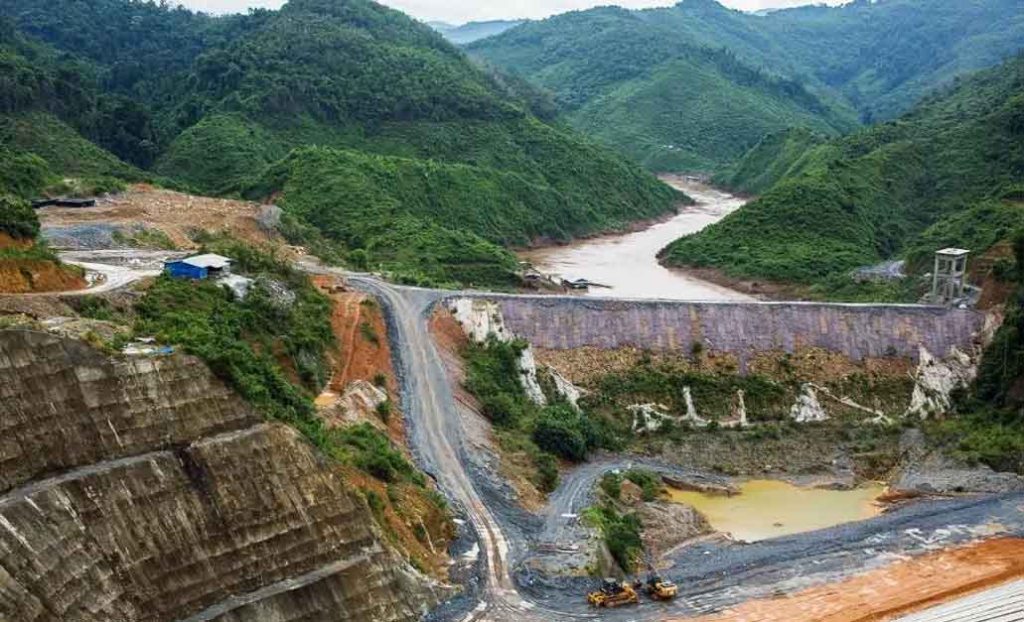
In the 21st century, the rise of China globally has been accompanied by a growing pattern of influence economically – “debt trap diplomacy”. This strategy offers large-scale infrastructure loans to developing countries vulnerable to financial pressure, often leaving smaller nations deeply indebted and politically burdened to China. Henning Melber’s China in Africa explored how this played into Africa, where Chinese investment in resource extraction and infrastructure sparks concerns about neocolonialism. Melber argues that this expansion is not just about development, but about China gaining access and taking control of resources in that developing country, at the expense of local autonomy and sustainability. These same patterns are emerging in Laos. An economically unstable country, Laos has become increasingly reliant on China for loans on infrastructure projects in the energy sector, and many Chinese owned businesses control major stakes in Laos’ energy sector. Through “debt-trap diplomacy”, China seeks to gain access/control of Laos by acquiring large stakes in Laos’ electrical grid in Laos and limiting Laos’ energy independence, serving as a form of neo-colonialism seeking to exploit Laos’ economic instability.
On March 25th, 2025, Laos’ Xekong Thermal Power Plant signed a $1.45 billion dollar clean energy agreement with China Western Power Industrial, majorly advancing Laos’ clean power generation and transmission efforts. This comes with the Laos-China 500kV interconnection project, launched in Vientiane in February, 2025. According to Power Technology, “the project, expected to be operational by 2026, will enable a two-way electricity exchange capacity of 1.5 million kW, delivering three billion kilowatt hours of clean electricity annually.” (Power Technology, 2025). Laos development has been rapidly increasing recently, with it majorly focusing on infrastructure and energy to catapult its economy, with ambitions to become “the battery of Southeast Asia”. Since 2014, Laos has been deepening its relations with China, particularly in the energy sector, allowing it to experience “a high economic growth rate of 8.2% (the highest in Southeast Asia), a high inflation rate of 6.9% (the second highest in the region), a low unemployment rate (1.9%), an increasing per capita gross domestic product (GDP) of US$1,505 from a growing GDP of US$10 billion in 2013” (Sari and Indradipradana 2024). Its partnership with China has clearly allowed for economic growth, with a vastly increasing GDP, which fuels Laos to continue its partnership with China, building its infrastructure, and growing its energy sector in order to successfully become the “battery of Southeast Asia”. Despite risks, evident by high inflation rates of 13.1% as of 2025, Chinese investment and partnership is tempting, and benefits from working with China seem to outweigh negatives, enticing Laos companies to partner with Chinese ones. In “Geopolitics of Laos Renewable Energy and the Development of Water Energy for the Integrated Southeast Asia’s Electricity”, authors Dr. Sari and Dr. Indradipradana argue that Laos is taking advantage of competitive market conditions and its partnership with China in producing water-based energy minimizes energy poverty and proves a net benefit for Laos. They write that “Laos has the ambition to develop its water-based energy (hydropower) to become the “battery of Southeast Asia”. Based on the International Hydropower Association (2023), Laos is estimated to have a hydropower potential of 26.5 GW, which results in Laos becoming one of the countries with the richest water resources in Southeast Asia” (Sari and Indradipradana 2024). With high potential in hydropower to supercharge the rest of the Southeast Asian continent, Chinese help in building this powerful trade factor into their economy is incredibly enticing, and is viewed by some as a great opportunity to quickly grow the Laotian economy and sustain this economy via profits gained from their energy sector.
However, the China-Laos relationship poses several concerns and issues, namely that of debt-trap diplomacy, power asymmetry, and Chinese control of Laotian energy and policy in the upcoming years of their partnership. Debt-trap diplomacy is defined as “a term to describe an international financial relationship where a creditor country or institution extends debt to a borrowing nation partially, or solely, to increase the lender’s political leverage”, and this kind of relationship is highly reflected in the Chinese-Laotian relationship. Laos’ ambition to be the “battery of Southeast Asia” through Chinese investing creates major power asymmetry between the two countries, where Laos appeals to Chinese power for economic advantages. According to an article in the journal Asian Perspective, “An IMF report in 2013 warned that the costly project would result in Laos’s external debt peaking and exceeding 60 percent of GDP during the next decade, with the ratio of debt service to revenue exceeding the 20 percent threshold in 2021 and remaining elevated for the entire pro- jection period (IMF 2013).”(Kuik 2021) These statistics directly affirm the fact that Laos’ debt is on the way to be almost uncontrollable, sparking concerns on how Laos will pay this debt back. Even worse, Laos may be forced to default on their loans just as Sri Lanka did in 2022, as a result of Chinese loans. Sri Lanka was forced to restructure deals totaling US$10 billion with China. This serves as a dangerous example of what may happen with Laos – the Laotian government may end up unable to return their debts in time and be forced to default on their loans. This majorly slows the nations’ economic growth and prevents alternative investment from overseas countries, which for the case of Laos, is detrimental if they ever want to leave the grasp of the Chinese government. Beyond worries about financial instability, China has gained large amounts of control on Laos’ energy sector. According to Dr. Sari and Dr. Indradipradana, “Financial assistance from China resulted in the Nam Ou hydroelectric power plant (PLTA) project in Laos being built by the Power Construction Corporation of China under China’s Belt and Road Initiative scheme. China has disbursed investment funds of US$2.8 billion by the agreement, allowing China to run the dam for 29 years … Laotian government, which revealed that the country could not manage and operate electricity due to large foreign debts.” (Sari and Indradipradana 2024). Therefore, with Chinese loans, Laos has lost control of their own energy, being unable to “manage and operate” the electricity. Without control of their own energy, Laos cedes control of their major assets to China, meaning that Laos loses access to the power source that can help Laos gain more influence in South Asia. Tiwari Sakshi from The Eurasian Times has described this as China “owning a country”, and writes that the massive loans from China to Laos have given Laos a major debt crisis, stating that “there is no other nation with a higher debt exposure than Laos”. According to The Eurasian Times, “The AP report noted China’s reluctance to forgive debts and the lack of transparency surrounding the amount and conditions of loans has prevented these countries from receiving financial assistance from other nations. This, analysts reckon, often leaves these indebted states with few options.” This provides a look into what may happen to Laos as it continues its dependency on China – lack of control of their power, stuck in a poor economic situation due to debts, and being forced to default on their debts, creating a vicious cycle of debts unable to be paid back. The Belgian colonization of the Congo is a parallel to the situation between China and Laos, where Belgium used the Congo’s natural resources to fuel its own economy, extracting wealth from Congo without regard for the local population. Similarly, Chinese companies in Laos are taking Laos’ resources with detriment to the Laos economy, and like how colonial economies were often trapped in a cycle of debt to the colonial power, Laos is in this same situation with China.
In Laos, concerns are rising amongst the Laotian people as well. According to C. Kuik and Rosli’s research article “Laos-China infrastructure cooperation: legitimation and the limits of host-country agency”, the Laotian people believe that a lack of alternative partner for Laos except China has constrained Laos’ developmental options, and Laos lacks agency to negotiate properly with China. In interviews the authors conducted with Laos citizens, “the Lao elites I talked to emphasized the importance of diversification; many highlighted “East-West” development corridor when the “North-South” corridor was mentioned, and most alluded to what Lampton et al. have termed “balanced connectivity” – a connectivity that “multiplies points of interdependence rather than simply focuses on links to China.” (Kuik and Rosli 45). In another survey conducted by the ISEAS Yusof Ishak Institute, they find that a growing number of Laos’ respondents have indicated worries about China’s growing economic influence and want U.S. influence in Laos. According to survey results, “72.7 percent of Laotian respondents indicated worry over China’s rising economic influence”(Lin). Therefore, worries about the Laos economy extend beyond the international perspective and draw directly from the Laotian people, concerned about the rising influence China is playing into their economy, hoping to seek a balance in foreign investment rather than it all coming from China.
In the present day, Laos is faced with a major debt crisis. Massive loans from China have given Laos “the highest debt exposure in the world”, raising concerns about Laos’ future, and creating dialogue regarding how Laos can stabilize its economic system right now. According to Sakshi Tiwari from The Eurasian Times, “In addition to a currency crisis, rising food and fuel costs worldwide have also contributed to the Laotian kip’s record low value against the US dollar, which has resulted in skyrocketing inflation.”(Tiwari). With the current economic crisis, if it gets out of hand, there is widespread anxiety amongst Laotian people that Laos could face an economic collapse. A preliminary solution to the Chinese “debt-trap diplomacy,” is for Laos to strengthen their ability to negotiate in Chinese Belt and Road Initiative policies, and that Laos should try to seek alternative financing sources and financial transparency in the Belt and Road Initiative. For Laos to strengthen their ability to negotiate with China, they should obtain more diverse diplomatic relationships and strengthen their domestic economy through human capital (education, training, technical skills, etc). Michael Hart writes that “Improved connectivity with its neighbors is only a partial solution for Laos. To raise public revenue and eventually pay off its debts, the Lao government will also need to enact domestic reforms to create an environment that is conducive for growth in business and entrepreneurship.”(Hart). There is a growing sense among Laotians that it is time for their country to look towards different countries to change its economic fortune, changing trading relationships to reduce Laos reliance on Beijing. Alternatively, the Laos government is advised to enact numerous stability measures such as increasing interest rates, which Tiwari Sakshi writes that the Laos government has already started “developing debt management strategies in collaboration with the Asian Development Bank.”(Tiwari). Looking forward in Laos-China relations, Laos should pursue a diversification of its partners in order to reduce dependence on China and to avoid falling into Chinese debt-trap diplomacy.
 The Megaphone