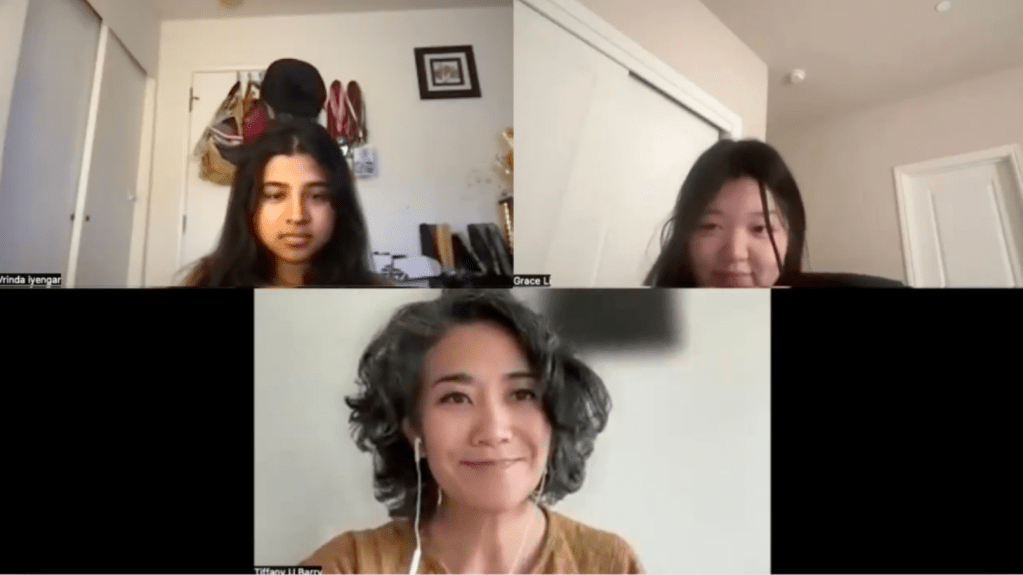
Authors: G. Li & V. Iyengar, Megaphone Editor-in-chief
Grace and Vrinda: Hi!
Ms. Barry: How are you both?
Grace and Vrinda: I’m good.
Ms. Barry: That’s nice to meet you. I’m Tiffany. And, well, I’m just curious. Like, how did you, how did you find my information?
Vrinda: We found you from a book you wrote called, Songs of the Sun, so we wanted to, talk to you because of that.
Ms. Barry: Okay. Well, I’m ready. What would you like to know?
Grace: Well, the first question we prepared is kind of in regards to an interview you gave previously. So you mentioned how growing up, you were surrounded by both Filipino and American music. So we were wondering, growing up, which artists or, like genres would you say developed your love for music? And how do you think that this has given you a unique perspective on music?
Ms. Barry: So genres and artists that affected my musical taste and and well, I would I was a super big Whitney Houston fan, and I still am. And she, you know, I actually got to see her in concert. Like, you know, I was born in Michigan, and then we moved to California when I was about six years old. And then when I was seven, my mom took my younger sister and I to see Whitney Houston at the Oakland Coliseum. And, you know, that was back when she still had big hair and everything. I have a very strong memory of being in the Oakland Coliseum, and she was wearing a pink suit and just being totally enamored with her music and her first album.
I also listened to a lot of my parents’ generation of music. They were into the Beatles and, you know, The Platters. They were just into a lot of American pop music. And then but then they also because they came from The Philippines, they listened to a lot of Filipino music. And so at least the ones that were that I remember growing up and hearing them listen to were Jose Marie Chan and and, Lea Salonga and and, a few others whose names I can’t remember. But, you know, Filipino music and then American music was, was a lot of what I heard from them. And then I had an older brother too who listened to a lot of hip hop and rap.
And so, there was the music that I heard at home. And then at school, I was listening to you know, I was playing violin, and I was doing, you know, violin lessons and singing in choir. So that was all very Western European classical focused. And so I feel like those different areas of music, those different genres affected it deeply, it deeply affected the way that I listen to all styles. I basically like any kind of music as long as it’s live.
I especially love live music even if it’s country music. But, I mean, a good melody is a good melody, and you can hear a good melody in any style or genre of music. But I particularly love singing, and, and so singing a good melody is always always my favorite thing to do. Yeah. I forgot the second part of that question.
Grace: Oh, it was just about how your love for these artists or genres, like, developed your love for music.
Ms. Barry: Oh, okay. Yeah. I mean, I just loved all styles. And when I would hear a new song, just through high school, I started to hear alternative music and metal and rock and roll. And then R&B. Yeah, just all of those styles, like, I don’t really have one.
Grace: Mhmm.
Ms. Barry: But all of them kind of spoke to the way that, like, I just love a good melody.
Vrinda: Okay. And speaking of your musical upbringing, are there any teachers that you think were able to uniquely encourage you musically or you learned a lot from or, their unique perspective on music from?
Ms. Barry: Yeah. I mean, there were, in my childhood, like, in my upbringing, I would say that there was one teacher that I did have who was actually Filipino, and I didn’t have any Filipino teachers. The one teacher I did have was a choir teacher, and I was in fourth grade, and she’s still alive. I actually saw her. She’s retired, but we’re Facebook friends. But back in the day, she was my fourth grade choir teacher, and I just remember seeing her. And, you know, back then, I mean, that was in the eighties. Like, I didn’t have there weren’t a lot of teachers of color. And so she was a music teacher, and she sang. And I just remember and I loved singing too. And I just remember thinking, you know, she looks like me.
She looks like I could be her, or she could be my auntie or my tita. And that was cool. I think just seeing her make music was cool and exciting, and then also because she was in a position of authority, and she was also Filipino – that stuck out to me. And then, when I was in middle school, I had an orchestra and band director. And I just remember him, he was very quiet, but I remembered you know, I sensed that, like, he believed in me and that, you know, he would encourage me to audition for different chairs in the orchestra. And, I just enjoyed being in his ensembles. He wasn’t very loud and, you know, music teachers oftentimes have big personalities, and he didn’t really have a big personality. But I could sense he was a gentle giant. Like, he was very encouraging and kind, and he was sort of funny. And he was very quietly funny in a way that you didn’t expect him to be funny, but, I always felt safe around him and like I could do things.
Grace: I think it’s really nice how these teachers encouraged you to go forward in your music career. So, I think as we mentioned earlier, we first decided to approach you for an interview after hearing about your book, Songs of the Sun. So, you mentioned in another interview that most of the music education that you had growing up was Eurocentric. So would you say that Songs of the Sun is a book you created to counteract the singularity in the cultural influence in music education?
Ms. Barry: Yes. Absolutely. That’s exactly why. And, you know, I was already teaching for almost twenty years when I came out with the book, and my intention wasn’t even to write a book. When you’re a music teacher and especially in elementary music, when you see all of those kids, like kindergarten to fifth grade, you see them only once a week. And when I was learning how to be a music teacher, for elementary students, there’s different curricula out there, like different content that you can choose to teach. A lot of it is very Western European based. I don’t know if both of you are doing orchestra, but a lot of the music, like classical music, are from Europe, and a lot of religious music, like Roman Catholic. And so, I guess I didn’t think it was possible until I saw another non Filipino music teacher present Filipino music, like, as content that I could possibly teach. I remember thinking, “I didn’t know that that was possible”.
But even in college and even when I would go to teacher training, the possibility of being able to teach from my own culture or music from my own culture didn’t seem like an option. And even in multicultural music curriculum. Like, teach Spanish, teach Chinese, you know, these are the two main cultures where there’s a big population in San Jose or in California or in The United States for that matter. But it still didn’t occur to me that you can actually do something in the Filipino language or in one of the dialects. And, it wasn’t until I saw it done that I thought, “oh gosh”. Like, I could do that, and why not? Why not try it? And so I started with some of the songs that I learned growing up from my parents, just children’s Filipino children’s songs. I adapted them for my classroom, for my music classroom.
And then, you know, it was actually a couple of my colleagues that were like, “you should be presenting this”. Like, “you should share this”. And so I did. I shared it at a couple of college classes and then, you know, more people were asking me to present. I presented at a national conference for Orff Schulwerk in Salt Lake City, like in February, 2019. And that’s where somebody came up to me and said, “you should write a book. We want to publish you”. And so that’s when the book came out, a couple years after that.
But, to answer your question, yes. It was to create more diversity in the music curriculum that’s available to educators.
Grace: Yeah. As someone who plays piano, most of the piano pieces I play are from Western culture. Those famous composers are all, like, European. So the idea of your book is something I think is really exciting and also something that I think is really good, especially for young learners.
Ms. Barry: Yeah. And, I mean, I think that, if you ever feel inspired to, write from your culture, like music that you heard growing up– because I know that there’s Filipino children just like myself when I was little. Like, I didn’t see Filipino music in the music classroom. I didn’t hear it. And so, you know, to create something where children like us feel seen in the classroom instead of always looking through a window and seeing somebody else’s perspective and their vision. You know, this is an opportunity for us to center ourselves as a marginalized community.
Vrinda: Yeah. I agree. I also think it’s really cool because, for me I grew up listening to a lot of Bollywood, and then I was also in orchestra in middle school. And enjoying those two types of music was always done in very different places. And so I think, yeah, it was just cool to see your book. And speaking on your career as a teacher, what initially drew you to music education?
Ms. Barry: Well, I needed money, and being a musician does not make a lot of money. [laughs] But where you can make a stable income is if you become a music educator, teaching at a public school, you know, getting a credential, a teaching credential, and getting a salary. I mean, living in the Bay Area is very expensive, and to have a steady income, being a music teacher is going to be more steady than auditioning for operas or bands and gigs. That’s not as stable. And you know, I had Asian parents. Asian parents are, like, very, you need to make money, be an accountant, be a nurse. Like, I had parents like that. And, it was already bad that I majored in music. Like, I had to do it behind their back, and that was a whole other drama. And the reality was too that, like, I do want to sing, I want to perform, but, I also want to get married and have a family, and I need to make money to be able to pay to live.
And so, that’s part of the reason why I went into teaching, but I also found that I loved it. I love just making music with anybody really, and making music with children is such a joy. Oftentimes, from middle school to high school, there’s a level of maturity, but also, self consciousness where you’re oftentimes kind of worried about, you know, like, dancing in front of your peers or singing out loud. And with children, there’s no filter. And there is not as much self consciousness because, you know, as you go through puberty, that’s what’s happening. You’re kind of defining yourself, based on your surroundings and your peers. Whereas, with children, you know, there’s more innocence and and more just awe for new things and readiness to try new things. But again, I love teaching all grade levels. So middle school and high school, and then I have college classes too. But I guess what I really enjoy doing is being in community with others to make music so we can all experience the joy together.
Grace: Yeah. So growing up, what did music represent to you as a child, and how would you say that has really changed now that you’ve gained more experience and have become a teacher?
Ms. Barry: Well, my experience with music and what it did to me. I have loved to sing since I was two and a half years old. That’s what I was told. And when I think about singing or just being in music, I feel like I am really alive. I feel like I’m present in the moment even when I’m nervous, even if I’m going to perform for a gig. Like when there’s a big audience, and I’m going to sing and I don’t know anybody and there’s a lot of lights, or I’m performing a new set of songs that I’ve never sung before, and I feel nervous. But I’m excited. And when I’m doing it, I just feel like I’m totally in my body and I just feel like every sense, every feeling I have inside of me is alive and just on. And it’s such an invigorating experience.
So that’s my own personal experience with music, and from the years that I’ve been alive and I’ve talked to students and other musicians and other music teachers and just other people in general, I sense that we as human beings all experience something similar, if not exactly what I experience. And it’s this strange and amazing connection we have to organize sound, which is music. Music is just organized sound. It’s patterns that come out of our vocal cords or the moving of our arm, with a violin bow on strings or the strumming on a guitar, or hitting a drum with your hands. It’s the sensation that comes from the making of music and the patterns that you can identify and hear and feel.
And I think that that feeling you have with music when you make it or when you hear it and it’s just so pleasing or it touches a part of you where it hurts or it just brings you joy and you just gotta head bang. Those experiences help keep us alive. I think that they help us want to be here and want to experience life, and I think everybody deserves that. And so if there’s anything that I can do to facilitate that to help people feel joy in making music or to feel connected to something, then I will, and if I can get paid doing that too, that’s cool. So, yeah, I think that if there was a mission that I happen to have just based on my own experiences with music, like, I would want other people to to experience the joy of making music and being fully alive in this connection to organized sound.
Vrinda: Yeah. And in an interview you were in that I listened to, I recall you talking about how growing up, you didn’t feel as though you fit in with Americans nor people in the Philippines, and, how while you traveled to The Philippines and listened to music there, you felt like you could connect with the people there for the first time. Can you explain more on how music helped you connect both of your identities and how it allowed you to feel as though you belong?
Ms. Barry: Well, a lot of it has to do with my past and you know, I’m not fluent in Tagalog. I’m not fluent in Ilocano, the languages that my parents spoke fluently. Because, you know, when we immigrated here, they didn’t teach us. They didn’t teach my brother or my sister and I, the languages, because they wanted us to be fully Americanized. They didn’t want us to have an accent. They didn’t want us to be discriminated against. And that was a loss for us because if I go back to the Philippines I can speak a little bit of Tagalog and be able to carry a conversation, but I’m not fluent. And even the songs that I have memorized that are in Tagalog, I’m not a fluent speaker, but I have the neural pathways and the memory of those languages and hearing it when I was a child.
And there’s a comfort in that. And I think when I do hear the language and I hear people speaking it, it’s kind of like going to church. Hearing the prayers reminds me of being young and feeling peace and feeling, like, memory. And that feeling feels like belonging. I know that there are certain spaces, like, I don’t belong in or they won’t really see me. So, I think knowing and trusting your own experiences and the things that you believe and you have felt in your family or in your culture or just the things that you know about yourself, I think that that’s probably a much more important belonging that will carry you through situations where you’re not going to belong everywhere.
Grace: Yeah, I feel like music kind of has a unique way of bringing people together, and I think that’s something that’s really cool about doing music.
Ms. Barry: Yeah, they often call it the universal language. Like, it’s the universal language.
Grace: So, what would you say is really a moment in your career that you, like, look back at and feel proud of?
Ms. Barry: That’s a hard question! [laughs] I guess the easy answer would be the book. And a lot of it is because, like, I didn’t really plan to make it. I didn’t plan to write one. And it seemed like the universe or, like, circumstances sort of led me in that direction. And I knew I felt like I wanted a part of myself to be out there, in my own music teaching experience, and I wanted to share it. And it seemed like other people also wanted to know, or other Filipinos wanted to see themselves in the classroom. They want to see our music there. And so I feel proud that I was able to contribute that, and also even just hearing you both say it inspires you to see something like that. And that makes me feel proud to be able to help others see themselves in something and then also want them to create something, you know, for themselves or for others. I think that’s really cool.
But, you know, personally, like, whenever I get to sing somewhere, if I have a gig and I get to sing solo, I love that. It doesn’t pay much, but it is super fun. And I’ve always loved singing, and so whenever I get a chance to sing, those are always the coolest.
Vrinda: So, finally, do you have any advice for younger musicians who are hoping to take their music further and make a career out of it?
Ms. Barry: I guess I would say that you should follow your instincts and trust them. I think that when you are young and you are told by a lot of people, who to be and how to be successful and who you are, it’s easy to be influenced. And, I mean, the whole world is doing that. Your elders do it. Your parents and teachers, they do it, you know, good intention. But at least in my experience, I feel like that has been equally encouraging and also detrimental because it also silenced my voice. It silenced my own trust in myself and what I wanted, what I knew I wanted and needed to live a full life.
And so I would say, let others share their opinion because everyone’s going to have an opinion on how you should live your life, but also pay attention to what it is that you need to be fully yourself, because nobody knows you better than you. And I think trusting that is going to lead you into situations and pathways where even if you make a mistake, even if it seems like it’s wrong, you actually have to make the mistake to learn what to do next or what to do better. So trust yourself. Trust your instincts. You will fail, but sometimes you won’t too. There will be successes and failures, and the failures do suck. They’re painful. But part of learning is failing, it is knowing what went wrong and what to do next. Or, like, now I need to go move in this direction, or I need to just, like, make a slight change. And that’s how we learn.
Vrinda: We’d like to thank you so much for agreeing to do this with us and hearing from you was really a great experience.
Grace: And I think other people who read this will really be able to learn from the knowledge you have given in this interview. So, just thank you.
Ms. Barry: You’re welcome. It’s great to meet you both, and it’s super exciting that you’re writing this newspaper. So proud of you both. Very exciting!
Grace and Vrinda: Thank you!
Ms. Barry: Take care.
Grace: You too. Have a nice day!

 The Megaphone