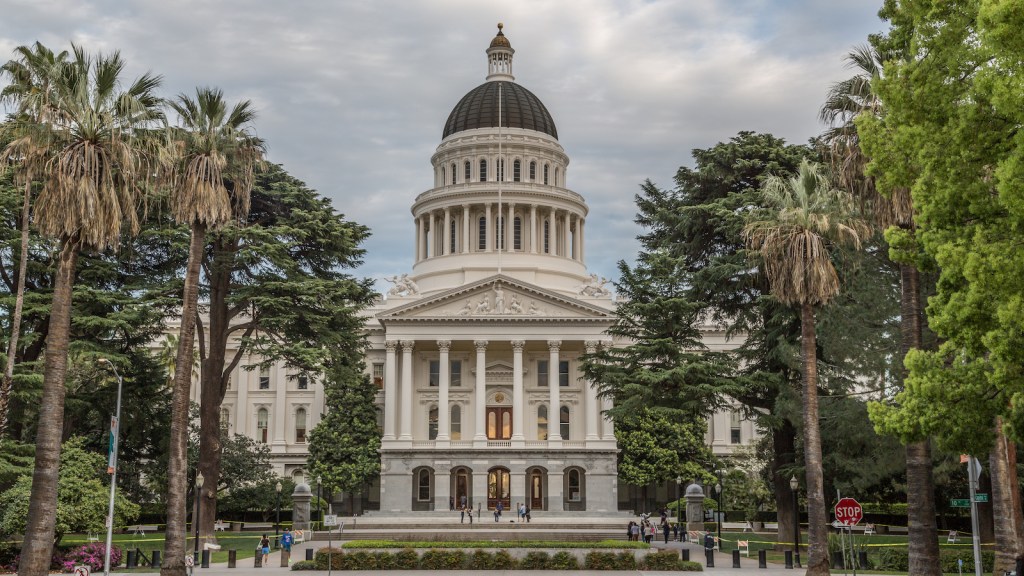
Author: V. Iyengar, Megaphone Editor-in-chief
Like the federal government, each state’s government is comprised of an Executive, Legislative, and Judicial Branch.
The Executive Branch
Analogous to the president of the country, the Governor of a state is the chief executive of the state and is responsible for enforcing state laws, signing/vetoing state legislation, and appointing heads of state agencies and departments. The current governor of California is Gavin Newsom. Each California governor can serve up to two terms.
The lieutenant governor is the second-highest executive in the state. The lieutenant governor will take on the governor’s duties if he/she is unable to serve. The lieutenant governor is also a key member of several state boards such as the University of California Board of Regents, etc.
Other elected officials in the executive branch head different agencies of the state. These positions include: the Attorney General, who oversees the Department of Justice –responsible for legal representation, public safety, and criminal justice policy; the Secretary of State who manages election procedures, business registrations, and the state archives; the State Controller, who is responsible for ensuring proper use of state funds (akin to a state’s accountant); the State Treasurer, who manages the state’s investments and debt, oversees the issuance of bonds, and handles public funds; the Insurance Commissioner who regulates the state’s insurance industry and enforces insurance laws; and the Superintendent of Public Instruction, who heads the Department of Education and oversees public school policy in K-12 education.
All electable positions of the Executive Branch will be up for reelection in 2026.
The executive branch also consists of state departments, whose secretaries are appointed by elected officials and then confirmed by the state senate. This departments include California Health and Human Services Agency (CHHS), California Department of Transportation (Caltrans), Department of Motor Vehicles (DMV), Department of Corrections and Rehabilitation (CDCR), California Environmental Protection Agency (CalEPA), California Department of Housing and Community Development (HCD), and the California Public Utilities Commission (CPUC).
The Legislative Branch
The Legislative Branch is composed of the State Assembly, the State Senate, and several other departments. The main responsibility of the Legislative branch is to write, debate, edit and pass laws for the state.
The California State Assembly is the Lower house of the Legislative Branch. It is comprised of 80 members who each serve two year terms with a limit of 12 years served in all (in either house).
All seats in the CA State Assembly are up for reelection in 2024 (and in every election year).
The full list of Assembly candidates per district can be found here.
The California State Senate is the upper house of California’s legislature. It is comprised of 40 state senators who each serve 4-year-long terms with the same 12-year term limit in either house. In addition to working on statewide legislation, the California state senate confirms gubernatorial appointments.
Out of California’s 40 senate districts, the 20 odd-numbered districts will be up for reelection this November. The rest of the districts will be up for reelection in 2026.
The Judicial Branch
California’s court system is comprised of three levels of courts: The CA State Supreme Court, the CA Courts of Appeals, and the California Superior Courts.
The CA Supreme Court
The CA Supreme Court is the highest Court in the state. It consists of a Chief Justice and 6 associate justices and is responsible for reviewing cases that involve significant/controversial legal or constitutional issues. Justices are appointed by the Governor but must stand for retention elections every 12 years.
Three state supreme court judges are up for reelection this cycle: Chief Justice Patricia Guerrero, Justice Goodwin Liu, and Justice Leondra R. Kruger.
If a justice is not reelected, the Governor of California appoints a replacement.
The CA Appellate Courts
The intermediate appellate courts in California hear appeals of decisions made by the California State Superior Courts. They review previous decisions for legal errors rather than re-evaluating the factual record. They are divided into six districts. Each district has several justices (the exact number varies).
The California Superior Courts
The California Superior Courts serve as the trial courts for the state, handling the majority of cases at the local level in each of California’s 58 counties. These courts have general jurisdiction over civil and criminal cases, covering a wide range of legal matters.
Judges on the superior courts can be either appointed or elected.
 The Megaphone