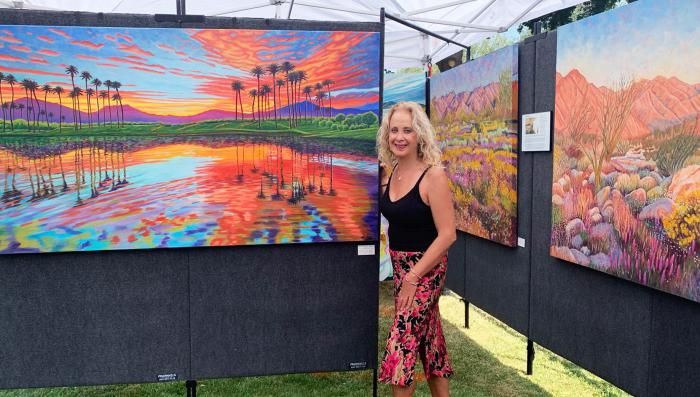
Authors: G. Li, V. Iyengar, Megaphone Editor-in-chief
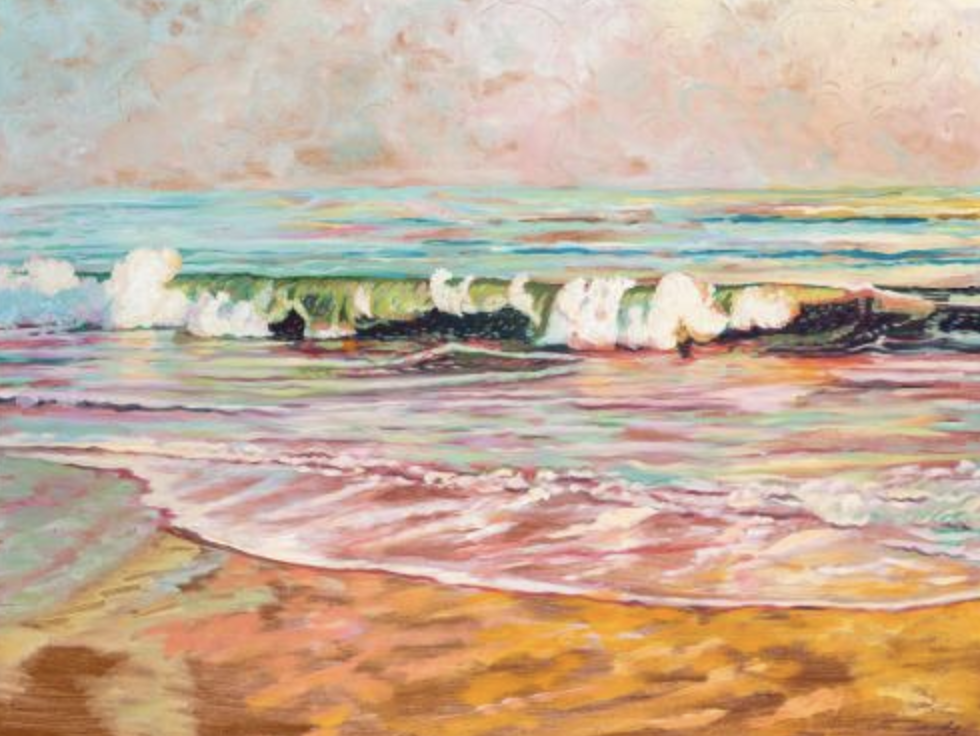
Jae-Lynn’s piece, Evening Glow
Q: Which qualities about a certain location or subject make you want to paint it?
I love the California landscape!
Coming from Europe, I used to paint Provence and Tuscany, two of the most beautiful places I knew, but then I began to appreciate what California has to offer. I am entranced by the rolling hills, ocean scenes, wildflowers, vineyards, trees, and hiking trails. I want to feel as if I am walking through the location i am painting and give the feeling of being there, immersed in the beauty.
Q: Do you have a favorite piece/What qualities of a piece make you prouder of it than others?
I am proud of the paintings that have won awards and have been selected for posters. That includes Wildflower Superbloom and Fiery Sunset Oasis. I also love Desert Landscape because it is so intricate and reminds me of the underwater flora that I love so much when I go scuba diving. All three of these paintings are desert scenes which have unusual qualities.
Q: In what ways do you find yourself expressing yourself and who you are through your art?
I have developed a unique style that expresses how I feel. I use bright colors to describe the joy I feel in the presence of nature. People say they feel happy when they look at my work. I am a happy person, and that comes through in my paintings via the energy and movement in my brushstrokes and the intensity of the colors that I employ.
Q: Most of your landscapes are marked by a consistent use of vivid colors and an overall vibrant style. Does that perception of California come from the fact that you grew up in London, which is known to be much less sunny, and/or are there other things about you that influence this view of the things you see.
I was depressed in London and escaped the gray by traveling around the world for seven years, till I arrived in California and settled down in Santa Cruz. Along the way, I discovered in the marketplaces of Asia, brightly colored spices and fabrics that opened my eyes to color. I copied the colorful paintings of Indian gods and goddesses and studied the art of Batik, where I learned to dye fabric in many colors. I used it as a painting medium because cloth was easy to transport. I spent five years in Asia, and it has had a lasting impression on my vision of life.
Q: Have there been any artists, pieces, or moments in your life that have contributed majorly to you finding the unique style that marks your paintings today?
Growing up in London, I used to visit the art museums regularly and was particularly struck by the paintings of Seurat in the National Gallery and the Turners in the Tate. As a young artist, I used to copy the paintings of Van Gogh and Gauguin. I visited Paris many times to see the Impressionist paintings in the Musée D’Orsay and Monet’s waterlilies in L’Orangerie. I was lucky to have these museums within fairly easy reach. I also experimented with abstract art. In the 1980s I was creating abstracts with biomorphic shapes and fairly recently I spent some time making and selling abstract expressionist paintings somewhat in the style of Jackson Pollock. I experimented with so many different styles that eventually I merged everything together to create my own vision.
Q: In what way(s) do you believe living all over the world has affected your outlook on life and art?
I am much happier and more optimistic since I traveled around the world and saw so many different cultures. It took me away from my own problems, and I try to evoke the joy and awe I feel in the presence of nature, which is, after all, our natural home. Also, traveling made me tough, and that’s what you need to be in order to survive as an artist!
Q: Are there any art styles you’d like to experiment with in the future, or anything you’d like to paint that you haven’t already?
I feel like I have experimented with many styles and motifs. If I look back over the years, I can see how I have evolved in styles and techniques. I love abstracts, portraits, and street art, and try to incorporate different techniques into my work, but I keep coming back to landscapes, and my individual style always takes over.
Q: Looking back on your life as an artist, what advice would you give to young adults who are aspiring artists?
I would tell aspiring artists to stick with it, even when the going gets hard. I experienced a significant drop in my income when I gave up my job to become a full-time artist and it was impossible for me to survive without some financial help from my parents for the first six years. After that, they could not afford to help me anymore and thankfully I was making enough money to get by. However, it is difficult to make a very good living as an artist, unless you take the academic route. Staying in college, or university, getting bachelors and master degrees, becoming a teacher, all those things help, but I was an independent and still am. So I make my living by doing art festivals. Becoming a full-time, professional and successful artist takes a lot of time, dedication, and perseverance, and not giving up if the money is not coming your way. It is probably best not to give up your job until you are making enough money from selling your art to survive, otherwise you will have to ask for help, and that is not always available. very few people continue with Art after college because they realize how hard it is to make a living, so it is a question of how tough you are and how much you want to compromise for your art. Only a very few survive, but you could be one of them!
 The Megaphone