Author: G. Li, V. Iyengar, Megaphone Editor-in-chief
📍Los Altos, CA
Please view part one of this interview before reading this article.

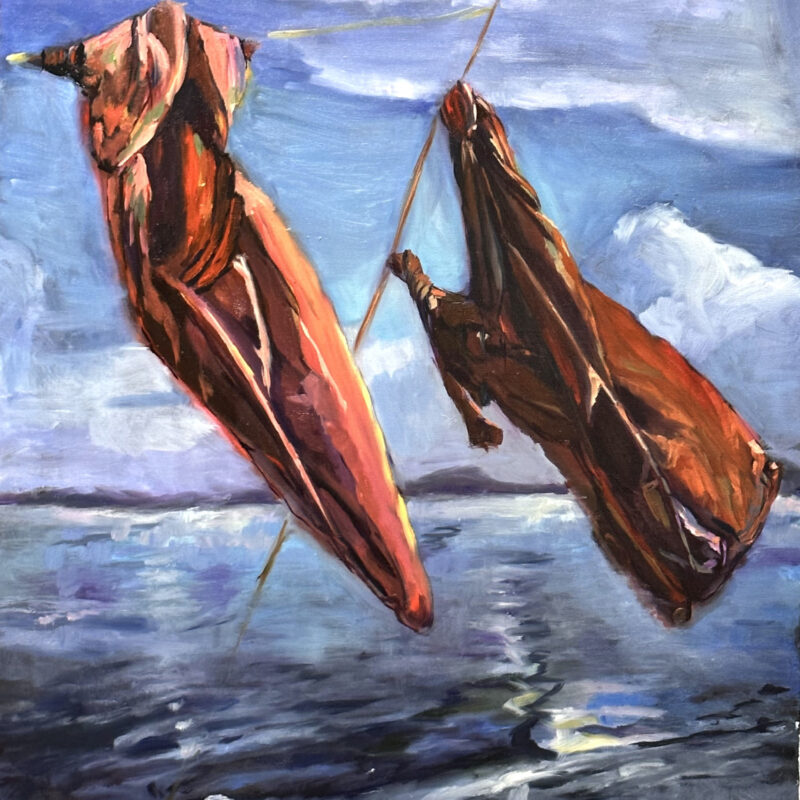
Cycle of Life, painted by Ayelet Gal-On
Grace: So I think you mentioned, looking back at your art and thinking, like, “oh, it looks good”. So, on your website, I saw that you mentioned that having shoulder surgery altered your style. So, if you don’t mind sharing, why do you think that having shoulder surgery changed your style, and why do you think it made you start exploring acrylic and more mixed media?
Ayelet Gal-On: Yeah. So, you know, I had one shoulder surgery, and then I actually took a break and didn’t paint. And, when I came back and tried to paint, I realized that it’s still not fine so I had to get a second one [shoulder surgery], which was very upsetting. There is nothing fun about it. But I decided the week after the surgery that I would not stop painting again, and I would go back and paint, and I would paint with what I’ve got, and what I got was my other hand. I couldn’t use my right because I couldn’t move my arm, so I could use my left.
So, for almost 2 years, I just used my left hand and not my right, which is— it’s challenging, but I look at it as an obstacle that opened another door for me, with all the pain and frustration. Because what I did first thing was buy many canvases and I bought acrylic paint. And the thing about acrylic, it’s more simple, sometimes, to deal with. So my first thing was just to take [it] very simple, to put one color on the canvas, and since the fine motors are different, when going from right to left, you don’t have the same ability as you developed for many years, so I just used my old hand, and gradually, I taught myself how to draw with my left hand.
So in the beginning, I started by gluing things, and that’s the advantage, each of the materials has a different advantage and disadvantage, and acrylic is more like a glue. You can glue many things. So I started by putting color and gluing things. And then I started drawing it.
So it was I feel like it’s open for me. And also, the other thing that I kind of discovered is that for each person that creates, there is also a voice that asks if it’s good enough or not good enough. If you are creating something, I’m sure that you ask yourself this question. Yes?
Grace: Yeah.
Ayelet Gal-On: Is it good enough? Am I good enough? Is it the right thing to do? But when I moved to my other hand, somehow, I didn’t have this voice, it disappeared.
Grace: Oh.
Ayelet Gal-On: So I found it very inspiring. And then I continued even when I went back to my my right hand, I continued to kind of be a bit more experimental.
Grace: I think it’s really inspiring that, like, even though you couldn’t use your right hand, you just started to learn how to use your left hand. I feel like maybe if it were someone else, they might just give up. You know?
Ayelet Gal-On: Yeah. We are going through, wherever we are in our life, each age, we’re learning, we have up and downs, and there are moments of giving up, and there are moments when we’re not giving up, but try to be determined.
Grace: Yeah. Oh, so another question that I had was, I also do art, so I was just interested in the creative process behind your art. Like, for example, how do you decide on, color palettes for your pieces or, when and where do you do your paintings? Or, for the subjects in your paintings, do you set it up and then paint it when it’s in front of you, or, do you imagine it?
Ayelet Gal-On: I have my area at my home, and my studio, so I’m going between 2 places. And then there are days that I’m not doing specific subjects— sometimes I just do just to keep on doing, which is the challenge, to always keep doing. Sometimes I just decide on what I want to do, and either I’m looking, taking pictures, and changing what I see [while painting it], or going 1 for 1, but mostly I’m changing and kind of editing what I see. I take it as a reference, something to help me, but not specifically trying to copy what I see. And, yeah. So it’s a combination. Sometimes I’m taking pictures of landscapes and I’m painting them because it’s pleasant just to continue and do something until you get into a specific direction.
Grace: I think that’s really good advice, like, in general for artists. Like, even if you don’t have a specific thing that you envision, just to keep painting.
Ayelet Gal-On: Yeah. The challenge is to understand also that there is always something. The thing is sometimes to eliminate the number of things that I want to do. Yeah? Because you can always do whatever is in front of you, whatever kind of interests you, and you can go and paint it, but then there’s so many things. And it takes time. Yeah. So you just have to choose. But, if you don’t have an idea, you can always just find something in front of you.
Vrinda: Yeah. Okay. So, moving on from that, are there any art styles that you’d like to experiment with in the future or anything you’d like to paint that you haven’t already?
Ayelet Gal-On: You know, I’m always between if I want to do more experimental styles— I do enjoy the representative— but I think I tried to, at one point, before I did my solo show, or last year when I did the open studio: I was interested to go a bit more 3D, but I kind of a constrained myself to do something with fabric, and I found it very challenging. But I still want to try to do 3D, to do something more sculpture-like. So, also, I did some artwork with the fabric, so it’s almost 3D, but I want to try to do more 3D. But I also want to continue to develop my representative and work with oil painting.
Yeah. And now I have a few things that I have in mind, so I just need the time and the space, and then to work [on a] larger [scale]. The size of the painting is also affecting how you work. So I think I would like to experiment to paint larger.
Grace: Something else that I wanted to ask was, as I was looking through your paintings and your exhibition pieces for Storyline, I found them really interesting. I just wanted to ask, what would you say is the main story or message behind the collection as a whole, and how does each piece contribute to the greater message behind the collection?
Ayelet Gal-On: You know, when I did it, my thought was, in one way, we are all the same. You know? Wherever we are in the world, we can connect with each other, because of the similarity that we have between us. And, I think each of the pieces, in a different way, examine that similarity. And, when I had the chance to speak with people, people from all over the world came to me and said, “I feel like this— this feels like my home in the Philippines,” or, “This feels like my home in China.”
There were quite a lot of people that were intrigued, by a painting that I did with a woman sitting and woman walking away. And she asked me what does it mean, and then I asked her to tell me. And she basically told me her “Storyline”, coming from China. So I think it touches people in a different ways, and people from different backgrounds, and we are very different from each other, but also we have a way to connect with each other through this kind of basic, nostalgic, kind of way of looking at things. Does it make sense?
Grace: Yeah!
Ayelet Gal-On: And, the painting that I’m talking about, I called it, “Should I stay there or should I go?”, and she told me that she left where she came from. And I’m an immigrant. So, I put it around the hanging clothes, and it’s kind of a story that repeats itself, not just the hanging clothes, but it’s kind of a similar experience that many people, especially here in the Bay Area, this experience living where they they were born.
Grace: Yeah.
Vrinda: Yeah. That actually answered another question we had, which was about like— we were wondering why, when you depict fabric, why like— what about clothes drying on a clothesline specifically is able to convey your message the best. And, it makes sense that it’s something that, happens over and over, and that also is nostalgic to lots of people who’ve immigrated to the Bay Area and other people too.
Anyways, when you like set out to paint something, what techniques such as color, shading, etc, do you use to convey certain themes and feelings?
Ayelet Gal-On: So, you know, there are techniques, paintings have specific rules on how to create something that looks 3D. So dark and light, hues, etc. I’m just following the rules, going away from the rules, but there is some guidelines about drawing, I kind of follow the rules of drawing of proportions. I don’t know if that answered your question.
Vrinda: It kind of did. It was like, how do you use, color and shading to create a mood or a message within a piece that you want other people to see.
Ayelet Gal-On: There was a time that I kind of emphasized turquoise. I don’t know. I wanted a bit more bright colors, and, I think after I came back from Costa Rica, I was inspired by color. So it creates some more vibrancy and interest. But then I decided to work on the background, and start with black, which it creates another mood. But, every session, I kind of, like, get into a different color that interests me to work in this time.
Vrinda: Okay. Yeah. Well, that’s, all the questions we prepared. We just had one more question. Looking back on your life as an artist, what advice would you give to young adults who are also aspiring artists?
Ayelet Gal-On: You know, I’m not sure that I have the answer, but I think one thing that I figured out this year was to be part of the community of artists and just join activities around [you]. Like now, I’m trying more to get into San Francisco, so I joined an organization that does open studios. I mean, it’s nice to do open studios because you can be in your studio and publish and invite the public to your space and get many people to come, but also, I joined this group and then I got to meet people.
And I think the more you get to meet people, you both create a network of people who know you, and you get inspired by other people, by other artwork, and by seeing what you like, what you don’t like, what attracts you, what is not attracting to you. So you get perspective. I’m sure there is the online community, but I think it’s also important to come and be present physically.
Grace: Thats great, thank you so much for answering all our questions!
Ayelet Gal-On: You’re welcome. In Gallery 9, you can come see my artwork, and let me know if you have any questions about classes and work.
Grace: Yeah, of course!
All: Thank you. Have a nice day.
Ayelet Gal-On: Goodbye.
If you want to view more of her pieces or contact her, please see her website linked here.
 The Megaphone