Author: E. Cherkuri, Megaphone Staff Writer
📍Pasadena, CA
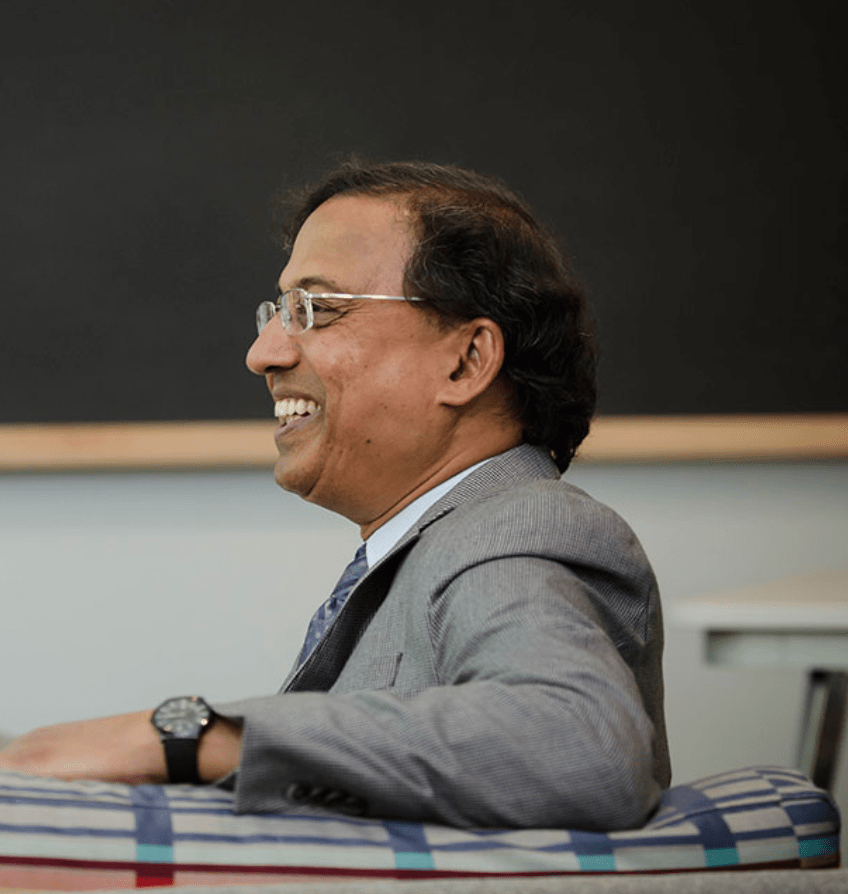
Renowned aerospace and mechanical engineering professor at Caltech, Ravi Ravichandran, shared insights into his illustrious career and offered advice to aspiring engineers during an exclusive interview. With over three decades dedicated to unraveling the mysteries of material deformation and fracture, Ravichandran’s work has been instrumental in fields ranging from automotive safety to space exploration.
Q: Please introduce yourself briefly.
Prof. Ravichandran: Yes, I am a professor of aerospace and mechanical engineering at Caltech. So I have been at Caltech for the last 30 plus years. You know, my research is in the area of mechanics of materials thinking about the deformation and fracture of materials.
Q: For people who are a bit confused on what your field is, can you explain it in simple words?
Prof. Ravichandran: Yes, so if you think about any material you can bend it, you can break it. So I look at the problems from a scientific point of view. How these materials deform, that’s change shape and also when does failure occur, why does failure occur, how it can prevent failures, and especially on the very high rates of loading, like impact and automobile crash and other things.
Q: So many people are unfamiliar with academia and the process of becoming a professor. So what made you choose academia and what made you choose to become a professor
Prof. Ravichandran: Yes, so to become a professor, especially in the university, you need a PhD. So when I started doing my PhD at Brown University, I saw a number of people ahead of me becoming faculty members. I was a assistant professor in various universities, and they kind of became my role models. And as I also started my academic journey doing research for my PhD, so I felt that I enjoyed doing research, thinking about new problems, and I felt that academia gives you the freedom to think about new problems and come up with solutions. And then you become the master of your own destiny, and I also like interacting with students and teaching, so that also was another motivation for me to become a faculty member.
Q: What are some of the projects that you are working on right now?
Prof. Ravichandran: So right now we are thinking about a couple of areas. One is looking at, if you have a defect in a material how does this defect behave when you apply very high amplitude of loading suddenly, and how does this void collapse, and that’s one of the problems we are thinking about.
Another problem we think about is granular media, how do the granular media deforms and their cyclic loading. This is for example very important, if you look at interaction of rovers like a Mars rover with regolith, that’s the soil, and you might have seen movies of the Mars rover getting stopped. So we try to understand, because as the wheel spins, the cyclic loading which is happening on the soil, and we try to understand the behavior of the soil.
Q: Okay, becoming a professor at Caltech must have definitely not been an easy feat. What was the hardest moment of your career this far, and what advice would you give to students when it comes to getting through moments like these?
Prof. Ravichandran: Yeah, I think, you know, I don’t know if there is a defining hard moment in my career, but I think this was a great privilege to be at Caltech. And what I would advise that, you know, you always find obstacles along the way in your career path. And whenever you face these obstacles, you know, you have to treat them as opportunities, and this is a very common saying. And, you know, what you think about is that rather than thinking of them as obstacles to your path forward, you’d say, how do I get ahead, you know, around the obstacle? So I think I would say there are two important things in this aspect. One is persistence or hard work. This is very important. That’s you need to put in the others to really, you know, solve the problem or, you know, the obstacle you face. And the other thing is you need to have the confidence in yourself and in the process. So these are, I think, that in mathematics, there is what’s called the necessary and sufficient condition when you prove something. And the necessary condition, I would say, is the hard work and persistence and other things. I think what is what I would call a sufficient condition for success or, you know, getting over obstacles is confidence. And many times I think people or students are even professors, they lack confidence in what they are doing and how they are going about it. And I think that stops them many times very cold, you know, from getting ahead.
Q: So are there any moments where confidence was essential for you to get something important, like done?
Prof. Ravichandran: Yes. I think this, you know, happened to me many times in research and people told me this can’t be done or, you know, problem can’t be solved. And I think I felt that I had sufficient background and knowledge to overcome those problems. And so we developed a number of experimental techniques, unique experimental techniques, because of the confidence I had in myself and also my students.
Q: Do you have something in your life, whether it be your colleagues, people you look up to, your family, etc., who continue to inspire your love for the field of study?
Prof. Ravichandran: Yes, I think, you know, I would say, you know, I am here in this position at Caltech because of the number of people who believed in me, you know, even though I didn’t believe that I could do those things. I think so what I generally tell people and also, you know, the students, whether you are 70 years old or 70 years old, you all need mentors, mentors.
So I have had truly outstanding mentors in my life. And this was especially the teachers who taught me, you know, especially my love of mathematics came from the teachers I had in high school and that’s when I was in college and that’s when I was in the graduate school. And also my colleagues inspired me to, you know, to shoot for higher, higher things. I mean, you know, they showed me sky is the limit and they supported me and provided me the confidence. I think there were, there are a number of colleagues, you know, who should enter my name list, but they were, they were very important in my life and they continue to be important in life. At the same time, you also need the support of the family. If you don’t have the support of the family, then, you know, it’s not so easy to advance in your career or in your profession. So I’ve been very fortunate to have a very supporting wife and children.
Q: Great, great. So now, is there any famous scientist or, or famous scientist in your field or any famous engineer that you idolize? If so, what about them or their mindset or their accomplishments do you admire most?
Prof. Ravichandran: Yeah, I think, you know, one of the great engineers I admire is the founder of my department, Theodore von Kommen. He was an amazing scientist, engineer, entrepreneur, scientific leader and advisor to the government. So he was instrumental in developing the principles, scientific principles of aerodynamics in the US and he was also important in the war effort during Second World War. And in recognition of that, he was awarded the first National Medal of Science by President John F. Kennedy. And so, you know, he’s a person I admire and, you know, what he accomplished. And the way he analyzed problems, looked at scientific problems and then turned them to be technological inventions. He was also the founder of JPL and did a very important figure in Caltech, in engineering and in aeronautics.
Q: Okay, so many of the audiences that are going to be reading this article are themselves immigrants from India or China or many other Asian countries. So as an immigrant from India, can you explain any instances of hardship or maybe like things that you needed to learn when you were starting your career in this country?
Prof. Ravichandran: Yes, I think when I first came to the country, I think what I had was the support of the community that’s not many but half a dozen or so Indian students, graduate students at Brown University, who helped me adapt to the system. Because, you know, coming to a new country, you’re to adapt to the new culture, you know, the way I think the one story, one story I can tell you is, you know, I had never eaten a hamburger in my life. So when I first came to Brown, you know, one of my fellow students, he pointed to the McDonald’s and said, this is where you can get lunch.
So that’s where I first got to have a good. So I think adapting to the culture is, you know, it takes time. The other thing is I missed the family back in India and I think that was, you know, again, that was helped by the friends I had at Brown. But I think in general, I think the US is a fairly easy place to adapt in some sense. But I think one has to come over, you know, the cultural and the language barrier and other things.
 The Megaphone