Author: G.Li, Megaphone Editor-in-chief
📍Silicon Valley, CA
The Silicon Valley, nestled in the southern part of the Bay Area in California, is widely renowned for its leading role in tech and innovation. Named after ‘silicon’, the chemical element whose semiconducting properties have enabled it to be used in transistors and integrated circuit chips in computer hardware, the Silicon Valley is home to thousands of startup companies and high-tech corporations, and leads the tech industry in the United States.

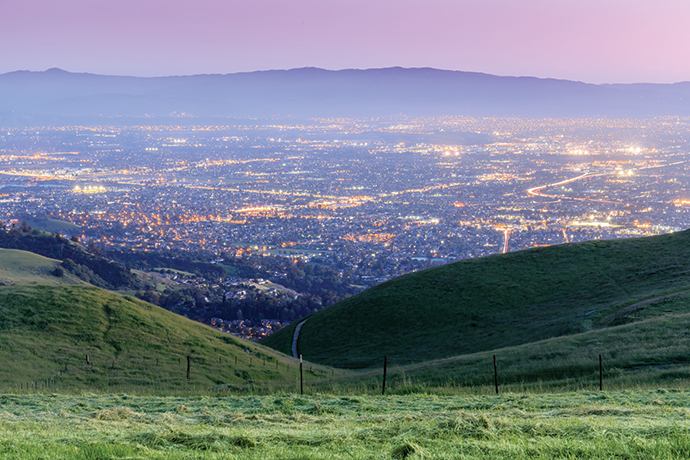
Image of the Silicon Valley
Originally, the region now referred to as the Silicon Valley was mainly known for the fruits grown on its soil, namely prunes. However, beneath the soil, the mecca of tech that the Silicon Valley is today was just beginning to sprout, with Stanford playing a major role in its fruition. In the 1950s, Frederick Terman, Stanford University’s dean of the school of engineering, encouraged his colleagues and students to start their own companies, and even led the formation of what is now Stanford Research Park, fostering numerous high-tech companies right on Stanford’s campus.
In 1956, William Shockley, living in Mountain View, started the Shockley Semiconductor Laboratory, and the work this lab did went on to serve as the basis for many electronic developments, allowing for the advancements creating the technology we see today. However, an argument over whether silicon or germanium would serve as the better material for making transistors created a major rift between the silicon and germanium advocates in the lab. This caused a group of 8 people who believed that silicon was the best material for making transistors to leave Shockley’s lab and start their own company, Fairchild Semiconductor. Later work by Fairchild Semiconductor would create the first monolithic integrated circuit chip, one of the most important technological inventions which enabled the invention of technologies that have defined the digital era.
Additionally, the space race during the Cold War Era contributed to the boom in new technology, with two major government organizations, NASA (National Aeronautics and Space Administration) and DARPA (Advanced Research Projects Agency), funding companies to develop new space-related technology, many of these companies being firms in the Silicon Valley. This led to development of technology in satellites, tracking, and microelectronics all happening in the Silicon Valley.
At Stanford Research Institute, Douglas Engelbart invented the computer mouse during the 1960s. Engelbart’s Augmentation Research Center at the Stanford Research Institute was also involved in ARPANET, a major precursor to the Internet.
Further nursing the growth of the tech industry in the silicon valley,, venture capital quickly became popular in the Silicon Valley, beginning with Kleiner Perkins and Sequoia Capital, and especially helped by the fact that during this era — the early 1970s — there were many semiconductor, computer, and programming companies. Venture capital boomed after Apple Computer’s IPO of 1.3 billion dollars in 1980, leading to Silicon Valley’s high concentration of venture capital firms.
From the 1970s-1980s the tech giants we know to define the Silicon Valley today: Apple, Atari, Oracle, Adobe, Cisco, etc., emerged. This influx of huge tech companies was in part aided by the creation of Silicon Valley Bank in 1983. This bank has played a crucial role in the Silicon Valley, specializing in giving banking services to Silicon Valley startup companies, helping them flourish, and become the companies they are today. Sadly, in 2023, Silicon Valley Bank collapsed, being one of the biggest bank failures in United States history. Although it is gone now, its contribution and its place in Silicon Valley history is one that will not be forgotten. The Homebrew Computer Club, created in 1975, also contributed to the creation of these tech giants. Based in Menlo Park, San Mateo, the Homebrew Computer Club was a group of computer enthusiasts, inspiring two of its members Steve Wozniak and Steve Jobs to design the Apple I computer, the first-ever product produced by Apple Inc.
Another significant contribution to tech made by the Silicon Valley were the many innovations in software and internet services created here. In the 1970-1980s, Xerox’s Palo Alto Research Center (PARC), a division of Xerox founded by Jacob Goldman in 1969, was huge in object-oriented programming, laser printing, graphic user interfaces, and Ethernet. Xerox inventions led directly to 3Com and Adobe Systems, and indirectly to Cisco, Apple Computer, and Microsoft.
As usage of internet boomed during the 1990s, a wave of Internet startups followed. The Silicon Valley is viewed to be the center of the dot-com bubble, also known as the Internet bubble, a period of time when investors invested heavily into Internet startups, hoping for their success so they could turn a profit. The dot-com bubble started in 1995, but it burst in 2000, with many Internet startups going out of business after failing to be profitable. It re-emerged in 2001, but in a weaker state.
In present times, the Silicon Valley still remains as a center of innovation and high-tech, home to a flourishing market of technology startups and businesses, housing a unique atmosphere of innovation and creativity that is sure to continue in years to come.
 The Megaphone